
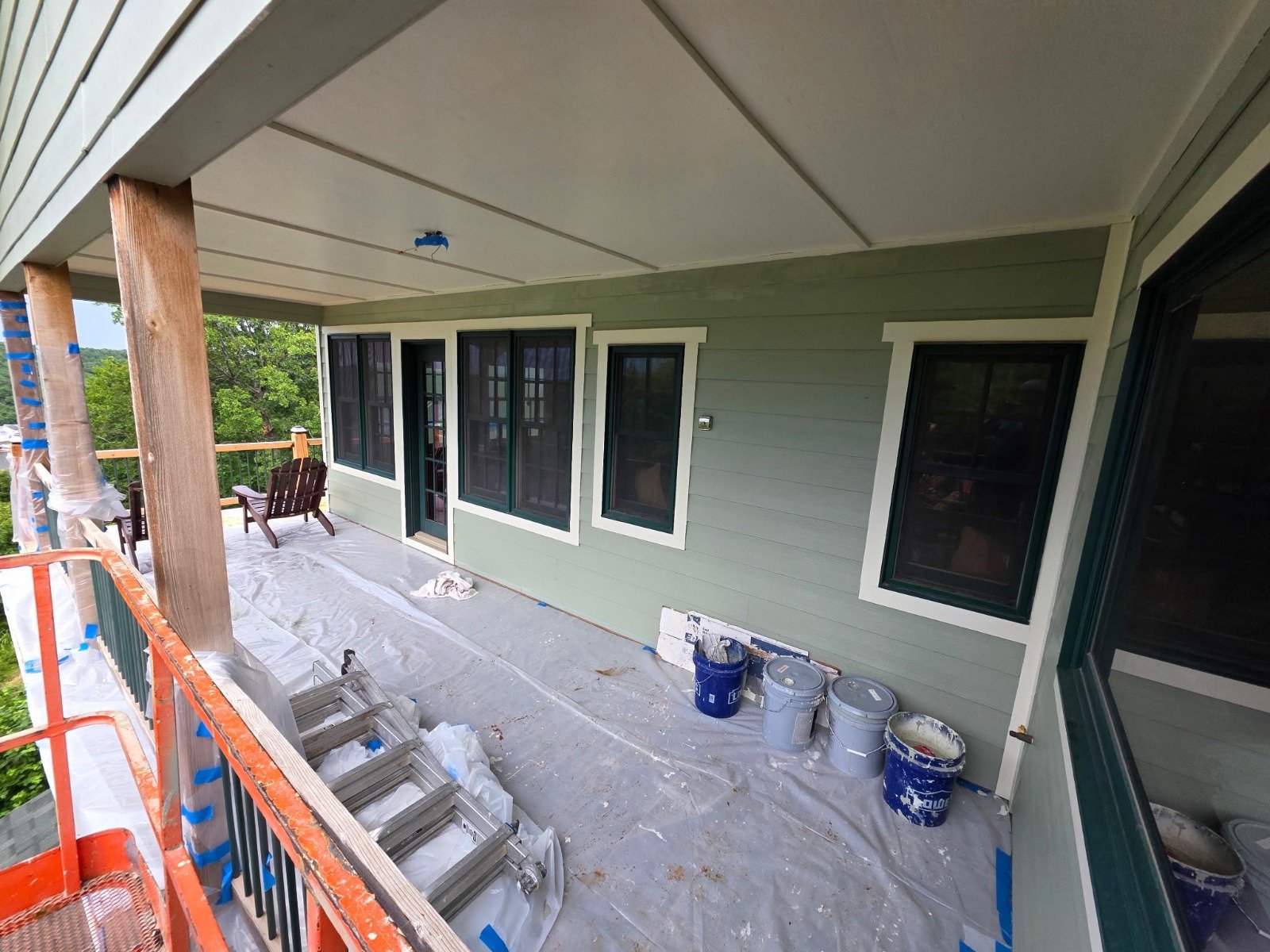
The Paint Job That Should Have Lasted Seven Years Lasted Two
It happens more than it should. A homeowner invests in a full exterior repaint — good contractor, quality product, solid application. The house looks great. Two seasons later, they’re looking at peeling paint on the north wall, blistering under the eaves on the west elevation, and fading that’s taken the south-facing trim from a rich color to something that looks like it’s been in the sun for a decade.
The homeowner calls the painter. The painter looks at it, talks about chalking, humidity, substrate issues. The conversation goes in circles. Nobody clearly explains why this is happening or what would have prevented it.
Here’s the clear explanation: exterior paint at Lake of the Ozarks fails faster than the same paint applied with the same technique would fail at an inland property. Not because the paint is defective. Not because the painter did poor work. Because the Lake of the Ozarks environment subjects exterior paint systems to a combination of stresses — persistent humidity, intense UV, biological growth, and Missouri’s freeze-thaw cycling — that no paint system survives without specific preparation and product choices calibrated for what the lake puts a painted surface through.
My Handyman LOZ has been handling exterior painting and restoration on lake properties throughout Lake Ozark, Osage Beach, Camdenton, Sunrise Beach, Laurie, Four Seasons, Porto Cima, Linn Creek, Eldon, and the surrounding communities since 1992. This article explains the specific failure mechanisms, what causes them, and what the preparation and product approach that produces paint life worth the investment actually looks like.
**📞 Call (573) 217-6060 | Text Photos for a Fast Estimate**
The Four Failure Mechanisms — Why Lake Paint Fails
Exterior paint failure at Lake of the Ozarks isn’t random. It follows specific mechanical and biological patterns driven by specific environmental conditions. Understanding which failure mechanism is producing the specific symptom on a given property is the first step toward addressing it correctly.
Failure Mechanism 1: Moisture-Driven Blistering
Blistering — the bubbles and raised sections of paint film that precede peeling — is the most common exterior paint failure symptom at Lake of the Ozarks, and it’s almost always moisture-driven.
Paint blisters form when moisture vapor pressure beneath the paint film exceeds the adhesion strength of the film to the substrate. Moisture infiltrates the substrate — through improperly caulked joints, through degraded surface coatings, through end grain in wood siding, or through substrates that weren’t dry at the time of application — and as that moisture is later driven out by heating (afternoon sun on a west-facing wall, for example), it pushes outward against the paint film. If the film’s adhesion isn’t stronger than the moisture vapor pressure, it lifts. The blister that results is not a paint defect — it’s physical evidence of a moisture management problem beneath the film.
At Lake of the Ozarks, the ambient humidity that surrounds lake home exteriors through the entire warm season provides continuous moisture input to wood substrates. Siding that dries adequately between rain events at an inland property is absorbing humidity from the lake air at a lakefront property — maintaining elevated moisture content in the wood that drives continuous blister-forming moisture vapor pressure in sun-heated conditions.
**The prevention:** Substrate moisture content within the application window specifications before painting, quality primer with moisture-blocking properties appropriate for the substrate and environmental conditions, and film thickness within the product’s specified range — thicker films have lower water vapor permeability but also higher internal stress.
Failure Mechanism 2: Mold-Driven Adhesion Failure and Peeling
Mold-driven paint failure is the mechanism that most surprises lake homeowners — because the paint looks fine from the outside while the mold is disrupting the adhesion bond between the paint film and the substrate from within.
Wood-decay mold species that establish in the wood fiber beneath a paint film produce enzymes that break down the wood cell structure, including the surface cells that the primer and paint film bond to. As the mold consumes the surface wood layer, it progressively weakens the substrate that the paint is adhering to. The paint film itself may be intact and properly applied — but the surface it’s bonded to is being degraded from below, and when enough of that surface has been compromised, the paint peels. Not from the top, but from the substrate upward.
This failure mode is almost always preceded by the same warning signs: small areas of paint lifting at the edges of lap joints, peeling that starts in the areas of heaviest biological growth history (north-facing walls, under eaves, behind downspouts), and an irregular peeling pattern that doesn’t follow mechanical stress lines.
At Lake of the Ozarks, the mold conditions that produce this failure mechanism are present at virtually every lake home exterior — the humidity, the shaded wall surfaces, the organic debris from surrounding vegetation. Exterior painting without thorough mold remediation of the substrate and application of a primer with mildewcide properties is painting over an active biological failure process that will produce peeling regardless of the paint quality.
**The prevention:** Complete mold assessment and treatment of the substrate before painting, complete removal of any existing mold-compromised paint film, application of a primer with mildewcide chemistry, and a finish coat that includes mildewcide additives.
Failure Mechanism 3: UV-Driven Chalking and Color Loss
Chalking — the powdery residue that appears on painted surfaces as the binder in the paint film degrades — and color fading are the exterior paint failure symptoms most visible on south and west-facing surfaces at Lake of the Ozarks.
UV radiation breaks down the binder chemistry in paint films over time — the same photodegradation mechanism that affects deck and dock wood affects the organic compounds that hold paint pigment in suspension and adhere it to the substrate. As binder chemistry degrades, pigment particles are released from the film surface, producing the chalky powder that transfers to the hand when the surface is touched. Color fading accompanies this process as pigment density in the surface layer decreases.
At Lake of the Ozarks, the UV loading on south and west-facing home exteriors is amplified by the reflective contribution of the lake surface below — surfaces receive both direct solar UV and reflected UV from the water, producing higher total UV loading than comparable surfaces at inland properties. Paint products with inadequate UV stabilizers exhaust their UV protection faster under this combined loading than their rated service life suggests.
**The prevention:** Exterior paint formulations with high-quality UV stabilizers for sun-exposed elevations, tinted primers that reduce UV transmission to the substrate, and product specifications appropriate for the geographic UV loading conditions at the property.
Failure Mechanism 4: Freeze-Thaw Stress on the Paint-Substrate System
Missouri winters deliver freeze-thaw cycling that stresses the paint-substrate system specifically at the points where moisture has infiltrated through the failures described in mechanisms 1 through 3.
Moisture trapped in wood fiber beneath a paint film expands when it freezes — the nine percent volumetric expansion of water becoming ice creates internal pressure against the paint film. Over multiple freeze-thaw cycles, this repeated pressure-and-release progressively weakens the adhesion bond at the paint-substrate interface. Combined with the other failure mechanisms that may already be advancing adhesion degradation, freeze-thaw cycling accelerates the timeline to visible paint failure.
The paint failure that appears at first thaw in spring is often the culmination of a process that was already in motion through the previous season — the freeze-thaw cycling doesn’t initiate the failure, it accelerates it to the visible stage.
**The prevention:** All of the moisture management steps that prevent mechanisms 1 through 3 also prevent the freeze-thaw substrate damage that mechanism 4 produces. A properly prepared, properly primed, and properly coated exterior at Lake of the Ozarks manages moisture through the summer and arrives at winter with less trapped moisture to freeze-thaw damage than an inadequately prepared surface.
The Preparation That Actually Prevents Premature Failure
The exterior painting failures described above share a common thread: all of them are primarily preparation failures rather than product failures or application failures. The right paint applied without the right preparation still fails at Lake of the Ozarks conditions — because the preparation is what addresses the specific failure mechanisms the lake environment drives.
Step 1: Professional Exterior Cleaning
The exterior surface needs to be professionally cleaned before any painting work begins — not as a courtesy but as the biological and contamination assessment that determines what preparation the surface actually needs.
Professional soft washing removes biological growth, oxidation layer, and surface contamination. What remains after cleaning tells the story: biological staining that cleaned off indicates surface contamination that was removable; biological staining that persists after cleaning indicates mold penetration into the substrate that needs treatment before painting. Blistering that’s visible after cleaning reveals the moisture vapor pressure points that primer selection needs to address. Chalking that cleans off reveals UV degradation at the surface layer.
Painting without this cleaning and assessment step means painting over an incompletely known surface condition — which is how paint jobs that look good at application fail before they should.
Step 2: Mold Treatment of Affected Surfaces
Any surface area with biological growth history — which at Lake of the Ozarks means essentially every north and west-facing wall, every under-eave surface, and every wood trim surface — should receive appropriate mold treatment before priming.
This treatment addresses the biological organisms in the substrate before they’re painted over. A mildewcide wash applied to affected surfaces and allowed to work before primer application eliminates the mold that would otherwise continue advancing beneath the new paint film and producing the adhesion failure that looks like a paint quality problem.
Step 3: Substrate Repair — Caulking, Wood Replacement, and Joint Treatment
Every failed or deteriorated caulk joint, every soft or degraded wood surface section, and every open joint or gap in the exterior assembly needs to be addressed before primer application.
Failed caulk joints are moisture infiltration pathways that will drive blistering in the freshly applied paint system as soon as lake humidity begins cycling through the joint. Soft wood sections with active mold damage need to be cut out and replaced with sound wood before the paint film is applied over them — the paint doesn’t protect compromised substrate; it conceals it until the compromised substrate produces visible failure.
At Lake of the Ozarks, caulking is particularly important around window and door frames, at the junction between siding courses, at any penetration through the exterior wall assembly, and at the transition between siding and trim. These are the joints that see the most thermal movement and the highest moisture cycling — the joints that fail fastest and that drive the most localized blistering when they’re not addressed before painting.
Step 4: Appropriate Primer for Lake Conditions
Primer selection for Lake of the Ozarks exterior painting isn’t the same as primer selection for a primary residence in a drier environment. The lake-specific requirements include:
**Moisture-blocking primers** for wood substrates that will be exposed to the lake’s elevated ambient humidity. These primers limit the moisture vapor transmission through the coating system that drives blister formation.
**Mildewcide-containing primers** for any surface with mold growth history. The primer is the first line of defense against mold reestablishment beneath the paint film — a mildewcide primer extends the interval before biological growth can threaten the new paint’s adhesion.
**Appropriate adhesion primer** for any surface where the existing coating system has been stripped to bare substrate. Adhesion primers create the mechanical and chemical bond between substrate and topcoat that determines how long the system holds together.
Step 5: Quality Topcoat With Lake-Appropriate Formulation
The topcoat — what most homeowners think of as “the paint” — performs only as well as the preparation beneath it allows. But product selection still matters, and the formulation characteristics that matter most for Lake of the Ozarks conditions are specific:
**UV stabilizer quality and loading** for sun-exposed elevations — the UV inhibitors in the topcoat determine how long the color holds and how long the binder chemistry remains intact before chalking begins. Quality exterior paint for lakefront applications should include high-grade UV stabilizers appropriate for the UV loading conditions at the property.
**Mildewcide additives** in the topcoat — extending the biological growth resistance through the full paint film thickness rather than only at the primer level.
**Appropriate film thickness** for the substrate and conditions — thicker films provide better moisture barrier performance but require proper substrate preparation to prevent internal stress failures.
My Handyman LOZ selects paint products and primers specifically appropriate for Lake of the Ozarks conditions — not generic exterior paint that performs adequately in drier environments but falls short of what the lake’s specific combination of stresses requires.
The Signs That Exterior Paint on a Lake Home Needs Attention
Homeowners familiar with the failure mechanisms above can recognize the early indicators that prompt timely intervention rather than waiting for full-scale paint failure:
**Chalking on sun-exposed surfaces** — the powdery residue that transfers to the hand when the painted surface is touched. Early-stage chalking indicates UV binder degradation that hasn’t yet progressed to cracking and peeling. This is the right time to clean, assess, and prepare for repainting — before the chalking surface degrades further and before the UV-exposed substrate below loses its intact surface layer.
**Small blisters near caulk joints, under eaves, or at lap joints** — early moisture-driven blistering that hasn’t yet progressed to peeling. The blisters identify the moisture infiltration locations that need caulking remediation before the new paint system is applied.
**Peeling that starts in shaded areas or follows mold-growth patterns** — the biological adhesion failure described in mechanism 2. Peeling that begins in the highest-mold-pressure areas (north walls, under eaves, behind downspouts) is typically biological rather than mechanical — which means substrate treatment is a prerequisite for any effective repaint.
**Color fading on south and west elevations** — UV-driven pigment depletion at the surface layer. Fading that’s progressed beyond the first year or two of a paint application indicates UV stabilizer exhaustion and the beginning of binder degradation.
**Surface texture becoming rough and porous-feeling on painted wood surfaces** — early-stage UV and moisture degradation of the surface layer beneath the paint that indicates the substrate is absorbing more moisture than a properly protected surface should.
The Vacation Rental and Investment Property Dimension
For Lake of the Ozarks vacation rental owners and property investors, the exterior paint failure timeline has revenue implications alongside the maintenance cost implications.
A freshly painted exterior is a marketing asset — it produces the listing photos that attract bookings, the first-impression arrival experience that shapes guest reviews, and the visual evidence of property care that supports premium pricing. A failing exterior paint system produces the opposite at each of those touchpoints: outdated listing photos, a disappointing arrival impression, and the “maintenance” language in reviews that compresses booking rates.
The paint job that fails in two seasons instead of five or seven isn’t just a cost problem. It’s a revenue problem for the seasons between application and failure — the seasons when the property is presenting with a deteriorating exterior rather than a maintained one. Getting the preparation right to produce the longer service life isn’t just about avoiding early repaint cost. It’s about maintaining the exterior quality through the full booking seasons that a seven-year paint life delivers.
Frequently Asked Questions — Exterior Painting at Lake of the Ozarks
01. Why does exterior paint on my lake home peel so much faster than at my primary residence?
The Lake of the Ozarks environment subjects exterior paint to a combination of stresses — persistent humidity driving moisture into substrates, biological growth disrupting adhesion from beneath the film, intense UV degrading binder chemistry on sun-facing surfaces, and freeze-thaw cycling stressing moisture-infiltrated paint-substrate interfaces — that most inland locations don’t produce simultaneously. The paint isn’t defective; the environment is more demanding, and the preparation needs to account for what the lake specifically puts a painted surface through.
02. How do I know if mold is causing my paint to peel or if it’s a different failure mechanism?
Mold-driven peeling typically starts in the highest-mold-pressure areas: north-facing walls, under eaves, behind downspouts, and any area that stays damp longest. It produces an irregular peeling pattern that doesn’t follow mechanical stress lines (joints, corners) but follows moisture and shade patterns. Moisture-driven blistering is more likely to appear near joints and penetrations. Both can be present simultaneously. Professional assessment after cleaning — which reveals whether staining persists in the substrate after biological surface growth is removed — accurately identifies what’s driving the failure in each area.
03. How long should a quality exterior paint job last at Lake of the Ozarks?
With thorough preparation — complete cleaning, mold treatment, caulking, appropriate primer, and quality topcoat with UV stabilizers and mildewcide for lake conditions — a quality exterior repaint on a Lake of the Ozarks home should last five to eight years before repainting is warranted. Without lake-specific preparation, the same paint applied without mold treatment, proper caulking, and appropriate primer may fail in two to four years.
04. Can you paint over existing paint that has some peeling, or does it all need to be stripped?
Areas with peeling paint need to be stripped to the point where the existing coating is firmly adhered and the peeling has been fully removed, edges feathered, and the exposed substrate treated before new paint is applied over. Painting over peeling without addressing the underlying cause produces paint that peels again from the same locations — often faster than the original peeling because the substrate issue has now been through another season of moisture cycling. Thorough preparation, not painting-over, is the only approach that produces a result worth the investment.
05. Do you use the same paint products indoors and outdoors on lake properties?
No — interior and exterior paint are formulated differently, and exterior paint for lake properties should be specifically formulated for the UV, humidity, biological growth, and freeze-thaw conditions that Lake of the Ozarks exteriors experience. My Handyman LOZ selects paint products appropriate for the specific surfaces, orientations, and environmental conditions at each property rather than applying a generic product to all surfaces.
06. Should I clean my lake home exterior every year even if it doesn’t need repainting yet?
Absolutely yes. Annual professional exterior washing that removes biological growth before it establishes beneath the paint film is the most effective way to extend the current paint job’s service life. Mold that gets into the paint-substrate interface in season two of a seven-year paint application can produce peeling by season four — cleaning that removes the biological growth before it reaches the substrate prevents this and extends the interval before repainting is warranted.
Paint That Lasts at the Lake Starts With Preparation That Matches the Environment
The exterior of a Lake of the Ozarks home deserves a paint system that’s prepared for what the lake puts it through — not a generic application that looks good at completion and fails before it should because the preparation didn’t account for the specific failure mechanisms the lake environment drives.
My Handyman LOZ has been preparing and painting lake home exteriors since 1992. We know the failure patterns the lake produces, we clean and treat substrates correctly before any product goes on, we select primers and topcoats appropriate for the specific conditions at each property, and we produce paint jobs that last the way an investment of that size deserves to last.
**📞 Call (573) 217-6060**
**📱 Text Photos for a Fast Estimate**
**🌐 Schedule Your Exterior Painting Consultation — Contact Page**
*Serving Lake Ozark, Osage Beach, Camdenton, Sunrise Beach, Laurie, Four Seasons, Porto Cima, Linn Creek, Eldon, and the surrounding Lake of the Ozarks communities since 1992.*