
The Most Expensive Mistake Lake Homeowners Make With Wood Replacement
There are two ways lake homeowners at Lake of the Ozarks spend more money than they should on deck and dock wood replacement. The first is waiting too long — letting a problem that would have cost a few hundred dollars to fix become one that costs several thousand. The second is paying for more replacement than the structure actually needs.
Both happen regularly. Both are preventable. And both come down to the same root issue: the replacement scope was determined before anyone actually knew the condition of the wood beneath the biological growth and surface staining that a lake environment deposits on every outdoor structure every season.
My Handyman LOZ has been assessing, repairing, and replacing deck and dock wood throughout Lake Ozark, Osage Beach, Camdenton, Sunrise Beach, Laurie, Four Seasons, Porto Cima, Linn Creek, Eldon, and the surrounding lake communities since 1992. In that time, we’ve seen what deferred replacement costs — and we’ve seen what over-scoped replacement costs. Both are avoidable with the right approach, and this article explains exactly how.
**📞 Call (573) 217-6060 | Text Photos for a Fast Estimate**
The Real Cost of Waiting Too Long
Let’s start with the version of wood replacement that costs the most — the one that results from deferring the decision past the point where targeted repair was still the right answer.
A single soft dock board caught early — one board, early-stage rot, isolated deterioration — is a straightforward, affordable replacement. The board comes out, the joist beneath it gets assessed and treated, a new board goes in with the right fasteners. The scope is defined. The cost is predictable. The fix holds.
That same board left in place for another full season sits in warm, humid Lake of the Ozarks conditions while the rot advances. Moisture cycles in and out of the deteriorated fiber. Biological growth that was surface-level works deeper. The rot — which is a biological process that doesn’t stop just because the homeowner hasn’t decided what to do about it yet — migrates to the adjacent boards. By the time the second season ends, what was one board is now a section of three or four boards and a joist that needs attention underneath.
Wait another season and the scope expands again. Now it’s a larger section, potentially a beam, and the fastener hardware throughout the affected area has been cycling through wet conditions long enough that connection integrity is a concern. What started as a $200 to $400 single-board replacement has become a $1,500 to $3,000 section replacement with substructure work.
This is not a theoretical progression. It is the standard cost trajectory of deferred wood replacement at Lake of the Ozarks, and My Handyman LOZ sees it on properties throughout the lake every season. The homeowners who catch and address the single board save money. The ones who keep meaning to get to it spend significantly more when they finally do.
**The cost of replacement scales with the time between identification and action.** This is one of the most consistently true things we can say about lake property maintenance — and it applies to dock boards, deck boards, railing posts, stair stringers, and every other wood component exposed to the Lake of the Ozarks environment.
How Cleaning Before Assessment Saves Money on Wood Replacement
The most consistently money-saving thing My Handyman LOZ does in the wood replacement process is something that happens before any replacement work begins: professional cleaning of the surface that needs to be assessed.
This sounds like an added cost. It’s actually the step that most reliably reduces total replacement cost — because biological growth and surface staining on lake deck and dock surfaces regularly conceal the actual condition of the wood beneath them.
Here’s what that means in practice:
**Boards that look like they need replacement often don’t.** Heavy mold and algae staining on a deck or dock board can make a structurally sound board look like a failed one. The dark discoloration, the rough surface, the generally deteriorated appearance — all of it reads as damage. But when that board is professionally cleaned and the biological cover is removed, it’s structurally intact. Firm underfoot. Able to hold fasteners. In perfectly adequate condition for treatment and staining rather than replacement.
How often does this happen? Consistently. On most Lake of the Ozarks properties that haven’t been professionally cleaned before a replacement assessment, somewhere between 20 and 40 percent of boards that were identified as likely needing replacement turn out to be structurally sound after cleaning. Replacing those boards would have been unnecessary cost — real money spent on lumber, fasteners, and labor that the property didn’t actually need.
**Boards that look treatable sometimes need replacement.** The reverse is equally important. Boards that appear stained but functional — boards a homeowner might assume are fine with a good cleaning and a coat of stain — sometimes reveal soft spots after cleaning that weren’t detectable through the biological cover. Pressing a cleaned board tells the truth that the algae and mold were hiding. Those boards need replacement. Missing them by assessing before cleaning produces a stain job that covers a structural problem rather than addressing it.
The cleaning-first approach to wood replacement assessment produces an accurate replacement scope — neither under-scoped nor over-scoped. It finds the boards that genuinely need replacement and identifies the ones that don’t. That accuracy is where the money is saved.
Targeted Replacement vs. Full Surface Replacement — Knowing the Difference
One of the most significant ways My Handyman LOZ saves lake homeowners money on wood replacement is through honest scoping that matches the replacement to what the structure actually needs — rather than defaulting to full surface replacement when targeted section replacement is the right answer.
Full deck or dock surface replacement has its place. When deterioration has advanced across the majority of the surface, when structural members throughout the substructure are compromised, when the accumulated maintenance history has produced widespread failure that makes targeted replacement a patchwork approach — full replacement is the correct scope and the honest recommendation.
But full replacement is not always the correct scope. And in many cases at Lake of the Ozarks, it’s not even close to the correct scope.
A deck with two soft boards in one corner and solid structural integrity everywhere else doesn’t need full replacement. It needs two boards replaced, a joist inspection at the affected location, and a treatment and staining program that protects the sound remainder of the surface. Proposing full replacement on that deck saves nothing — it costs the homeowner the full replacement price for a problem that a targeted repair addresses correctly at a fraction of the cost.
My Handyman LOZ has been doing this work since 1992. We have no financial incentive to propose full replacement when targeted replacement is what the property needs — because our reputation in this lake community is built on honest assessment, and because the homeowners who trust our assessment become the long-term clients and referral sources that have sustained the business for three decades. The honest scope is always the right scope, and in most cases, the honest scope is considerably less than the maximum scope.
**How we determine the right scope:**
- Professional cleaning first — removes the biological cover that conceals actual board condition
- Systematic board-by-board pressing — the definitive structural test for every board on the surface
- Substructure inspection — assessing joists, beams, and connection hardware at and beneath the surface
- Honest categorization — boards that need immediate replacement, boards approaching the threshold, boards that are structurally sound and can be treated and extended
- Clear communication — the full picture, presented to the homeowner before any work is proposed
The result is a replacement scope that matches the structure’s actual condition — not the maximum that could be proposed, and not the minimum that leaves real problems unaddressed.
The Stain Timing Rule That Prevents Wasting Money
There’s a specific sequencing mistake in deck and dock wood replacement that costs lake homeowners money every season — and it’s entirely avoidable with the right information.
**Staining new pressure-treated lumber before it has adequately dried produces a stain job that fails prematurely.** New pressure-treated lumber contains elevated moisture from the treatment process — typically requiring 30 to 90 days of drying before stain can penetrate and bond properly. Applying stain to lumber that hasn’t dried adequately produces a surface bond rather than a penetrating bond. The stain looks fine initially and fails within a season — peeling, flaking, or developing the mottled appearance of a finish that never adhered correctly.
When this happens, the stain job needs to be stripped, the surface needs to be properly prepared, and the staining needs to be done again — at double the original staining cost. The replacement lumber was installed correctly. The stain application timing was wrong. The result is a project that cost twice what it should have.
My Handyman LOZ advises every wood replacement client on the appropriate drying window for the specific lumber installed and the specific conditions at the property. We don’t stain new lumber before it’s ready — because producing a stain job that holds is the outcome the client is paying for, and getting there requires respecting the drying timeline that new pressure-treated lumber needs.
For STR investors with booking calendars to consider: replacement completed in early spring allows the 30-to-90-day drying period to run before peak-season staining — a timeline that makes April replacement and Memorial Day staining a realistic sequence. We work with vacation rental owners to plan replacement and staining timing around the booking calendar so the property is stained and finished before the season’s highest-occupancy stretch.
How Protective Coating After Replacement Saves Money Long-Term
The replacement cost conversation often focuses on the immediate project — how many boards, what material, what the labor runs. But the most significant long-term cost savings in wood replacement comes from what happens after the new boards are in.
Deck and dock boards installed without protective coating on a Lake of the Ozarks property are exposed to the full biological and moisture load that the lake environment delivers continuously from May through October. Algae establishes on bare wood surfaces within weeks. Mold follows the algae. Moisture cycles in and out of unprotected wood fiber with every weather event. UV exposure on sun-facing surfaces breaks down surface cells and opens grain for accelerated moisture infiltration.
The replacement interval on unprotected new lumber in these conditions is measurably shorter than on properly protected lumber. Boards that are professionally cleaned, allowed to dry, and stained with a penetrating mildewcide product after installation have moisture protection, biological growth resistance, and UV protection working in their favor from day one. Boards installed without protective coating start deteriorating toward the next replacement from the day they’re exposed to Lake of the Ozarks conditions.
The cost difference in replacement interval between protected and unprotected lumber is significant — potentially five to eight years of additional service life on protected boards versus unprotected ones under similar lake exposure conditions. A stain job applied correctly after replacement isn’t just a finishing detail. It’s a long-term investment in the replacement interval on the lumber just installed.
Ground-contact rated pressure-treated lumber — the appropriate specification for dock and deck replacement in a lake environment — combined with quality penetrating stain with mildewcide applied to dried lumber is the combination that produces the longest replacement intervals and the best long-term cost outcome for Lake of the Ozarks homeowners.
The Material Selection Conversation — Getting It Right the First Time
Not all replacement lumber performs equally in a lake environment, and the material selected for a wood replacement project has a direct bearing on how long that replacement holds — which means it has a direct bearing on when the next replacement cost arrives.
**Ground-contact rated pressure-treated lumber (UC4B or UC4C)** is the appropriate specification for Lake of the Ozarks dock and deck replacement. Treatment ratings matter: above-ground rated pressure-treated lumber (UC3B) underperforms in the persistently damp, biologically active conditions of a lake dock environment and reaches the next replacement threshold faster. The cost difference between treatment ratings at the material level is modest. The cost difference in service life is significant.
**Cedar** is the premium natural alternative for lake deck and dock replacement — naturally rot-resistant, dimensionally stable under moisture cycling, and accepting of stain beautifully. Cedar costs more than pressure-treated pine at the material level and is worth the premium on properties where appearance quality matters and maintenance consistency is reliable. On heavily shaded properties throughout Camdenton and the Grand Glaize arm where natural rot resistance matters most, cedar delivers a meaningful service life advantage.
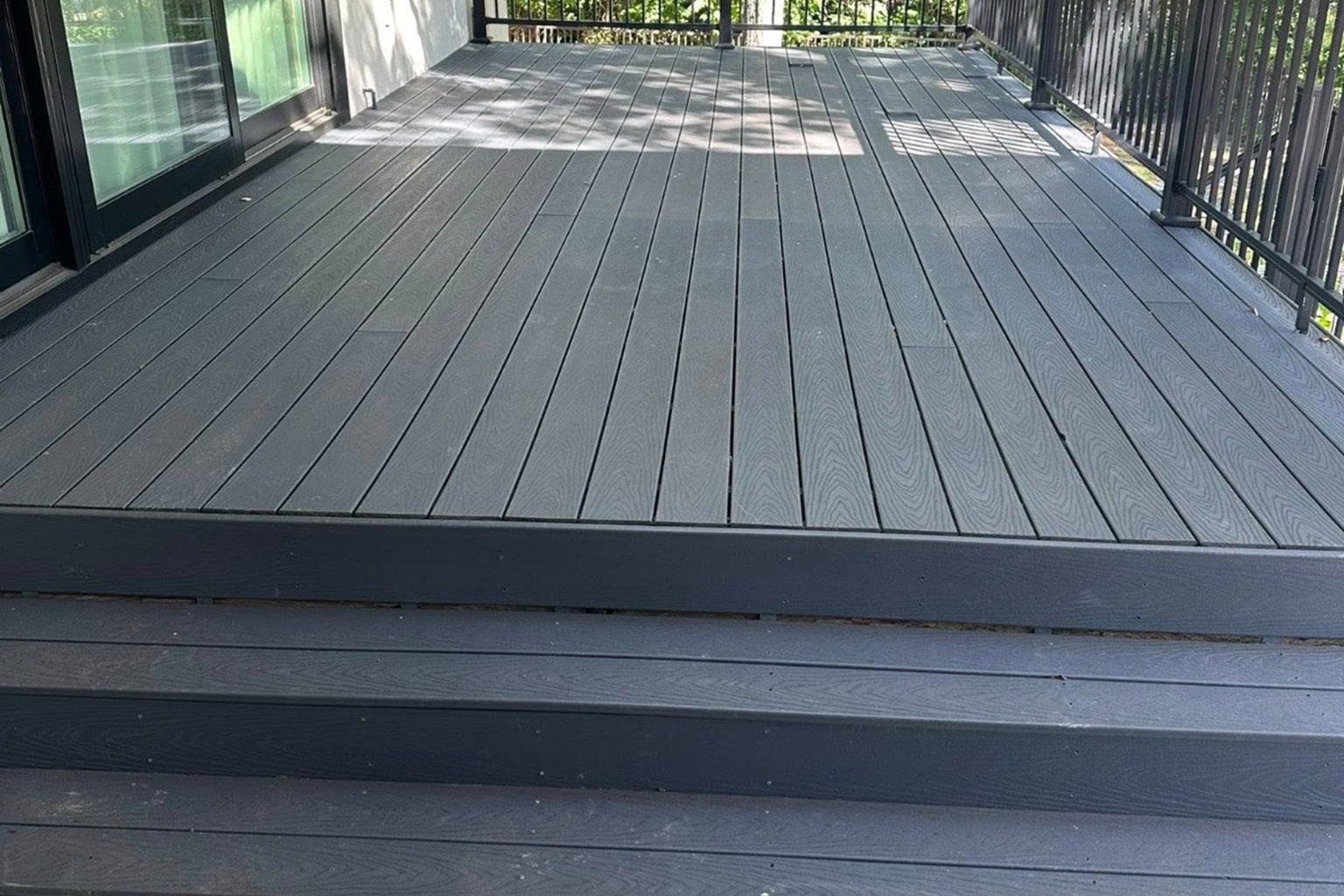
**Composite decking** offers the longest replacement interval of the available options and the lowest long-term maintenance cost — composite materials don’t rot, don’t require staining, and resist the biological growth that wood surfaces in lake environments support. The upfront material cost is higher than wood alternatives. For high-traffic vacation rental properties in Osage Beach and Lake Ozark where maintenance frequency is a real operational consideration, composite’s lower long-term cost of ownership often makes it the most economical choice over a ten-year ownership horizon.
My Handyman LOZ discusses material options honestly with every replacement client — presenting realistic longevity expectations, maintenance requirements, and total cost of ownership for each option so the material selection is based on what serves the property’s specific conditions and the owner’s specific priorities.
What My Handyman LOZ Specifically Does to Save You Money
Let’s be direct about the specific practices that consistently reduce wood replacement costs for Lake of the Ozarks homeowners who work with My Handyman LOZ:
**We clean before we assess.** Biological cover conceals board condition. Cleaning reveals it. Accurate scoping starts with a clean surface — and accurate scoping is what prevents both under-replacement (missing boards that need attention) and over-replacement (proposing replacement of boards that don’t need it).
**We scope to actual condition.** The replacement scope is determined by what the systematic assessment after cleaning reveals — not by what would generate the most revenue for the contractor. When targeted section replacement is the right answer, that’s what we propose. When individual board replacement addresses the problem, that’s what we recommend.
**We inspect the substructure.** Every replacement project includes inspection of the structural members beneath the surface. New boards on compromised joists reproduce the problem faster than the original installation. Identifying and addressing substructure concerns at replacement time prevents the follow-up project that a missed joist creates.
**We advise on drying time before staining.** We don’t stain new lumber before it’s ready. The appropriate drying window is communicated clearly, and staining is scheduled for when the lumber’s moisture content allows proper penetration and adhesion. This produces a stain job that holds rather than one that requires redoing.
**We match fasteners to the environment.** Standard galvanized fasteners corrode in the persistent moisture of a lake dock environment and lose holding strength within a few seasons. My Handyman LOZ specifies stainless steel or hot-dipped galvanized fasteners for replacement work — the additional material cost is a rounding error against the structural consequence of fastener failure in wood that was just replaced.
**We recommend protective coating after replacement.** The long-term cost of ownership on replaced lumber is determined significantly by whether it gets protective coating applied correctly after installation. We’re not in the business of producing replacements that need to be replaced again in five years. Quality materials, correct installation, appropriate protective coating — that’s the sequence that produces replacements that last.
Signs Your Lake Property Wood Needs Replacement — And What to Do First
If you’re seeing any of these on your Lake of the Ozarks deck or dock, the right first step is a professional cleaning and assessment — not a replacement quote:
- Boards with visible dark discoloration, algae, or mold that hasn’t been professionally cleaned recently
- A general sense that the deck or dock looks weathered and deteriorated that could reflect either surface contamination or structural failure
- Soft spots that you’ve noticed but haven’t had assessed since the surface was last cleaned
If you’re seeing these, the structural threshold has likely been reached and assessment should move quickly:
- Any board that compresses or feels spongy when pressed firmly underfoot
- Deep longitudinal cracking that goes through the full board depth
- Boards that have cupped significantly or lifted at fastener points
- Any railing post with movement under lateral pressure
- Stairs or ramps that shift or feel different than they used to
When in doubt: call (573) 217-6060 or text photos of the surface to get a preliminary read before scheduling a full assessment. Many wood replacement conversations can be scoped accurately enough from photos to give homeowners a realistic picture of what they’re dealing with before a site visit is needed.
Frequently Asked Questions — Wood Replacement Cost Savings at Lake of the Ozarks
01. How does cleaning before assessment actually save money on wood replacement?
Biological growth and surface staining regularly conceal the actual structural condition of deck and dock boards. Boards that appear to need replacement often turn out to be structurally sound after professional cleaning reveals actual wood condition. Boards that appear treatable sometimes reveal soft spots that weren’t detectable through biological cover. Cleaning first produces an accurate scope — which means replacement isn’t proposed for boards that don’t need it and isn’t missed for boards that do.
02. Is targeted board replacement ever more cost-effective than full deck replacement?
In most cases, yes — significantly more cost-effective when the deterioration is isolated rather than widespread. Full deck replacement is the right scope when deterioration has advanced across the majority of the surface and structural members throughout the substructure are compromised. When isolated sections or individual boards are failing while the rest of the deck is sound, targeted replacement addresses the problem at a fraction of the full replacement cost.
03.How long do replacement dock boards typically last at Lake of the Ozarks?
Ground-contact rated pressure-treated lumber with consistent professional cleaning and proper staining after adequate drying typically lasts 15 to 20 years on a Lake of the Ozarks dock. Without protective staining, that interval shortens meaningfully. With appropriate treatment rating and consistent maintenance, the upper end of that range is achievable.
04. Does the type of wood I use for replacement affect long-term cost?
Significantly. Ground-contact rated pressure-treated lumber (UC4B or UC4C) outperforms above-ground rated material in lake environments and justifies its modest cost premium through extended service life. Cedar offers additional performance advantages in shaded, high-moisture positions. Composite eliminates the rot and staining maintenance cycle entirely at a higher upfront material cost with lower long-term ownership cost.
05. What happens if I stain new replacement boards too soon?
Staining pressure-treated lumber before it has adequately dried — typically 30 to 90 days depending on the specific product and conditions — produces a surface bond rather than a penetrating bond. The stain fails prematurely — peeling or flaking within a season — and the surface needs to be stripped and re-stained. The additional cost of the failed stain application and the redo is entirely avoidable with the right drying timeline.
06. Can I get a preliminary estimate for wood replacement by texting photos?
Yes. Text clear photos of the deck or dock surface — including any areas where soft spots have been noticed or where deterioration is visible — to (573) 217-6060 for a preliminary assessment. Many scoping conversations can be started from photos before a site visit is needed, which lets homeowners get an early picture of what the project involves before committing to a full assessment appointment.
The Most Expensive Wood Replacement Is the One That Could Have Been Avoided
The homeowners who spend the least on wood replacement at Lake of the Ozarks are the ones who catch problems early, assess accurately, scope honestly, and protect their replacement lumber with quality coating applied in the right sequence. None of that is complicated. All of it requires working with a contractor who prioritizes the right outcome over the maximum scope.
My Handyman LOZ has been delivering that approach to lake homeowners and vacation rental investors since 1992. We assess honestly, replace what needs replacing, protect what doesn’t, and finish the work in a sequence that makes the investment last.
**📞 Call (573) 217-6060**
**📱 Text Photos for a Preliminary Assessment**
**🌐 Request Your Free Estimate — Contact Page**
*Serving Lake Ozark, Osage Beach, Camdenton, Sunrise Beach, Laurie, Four Seasons, Porto Cima, Linn Creek, Eldon, and the surrounding Lake of the Ozarks communities since 1992.*