
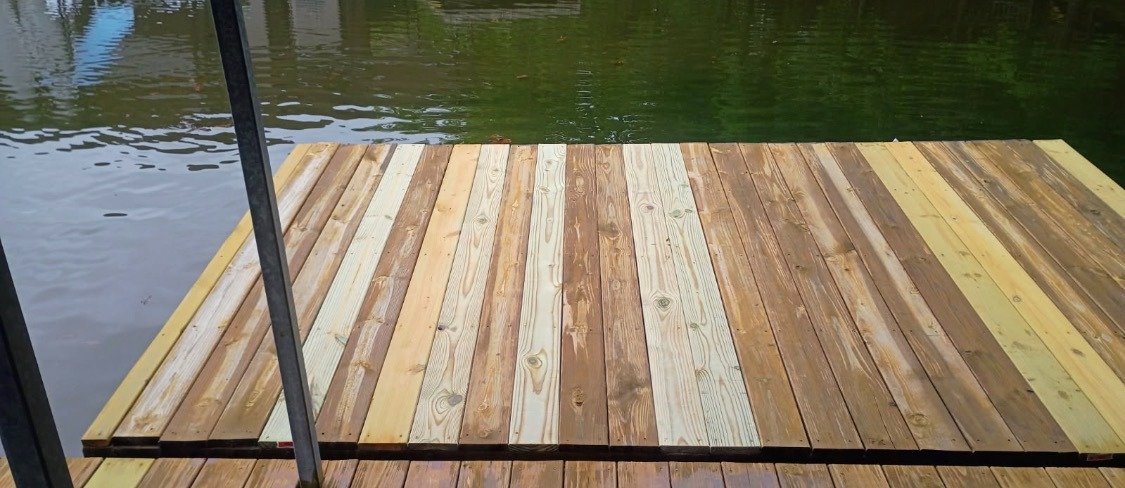
What Looks Like a Stain Is Actually a Safety Crisis in Progress
It starts as a faint greenish tint on the dock boards near the water. By June it’s a slick biological film covering the middle sections. By August, if nothing has been done about it, the entire dock surface has that characteristic green-brown sheen that every Lake of the Ozarks homeowner eventually learns to recognize — and that far too many learn to walk around rather than address.
Algae on a lake dock is one of the most consistently underestimated hazards in lakefront property ownership. It looks like a maintenance issue. It presents like a cosmetic problem. But beneath the surface — literally and figuratively — what’s happening is structural, biological, and in the wrong set of circumstances, dangerous enough to send a family member or guest to the emergency room.
My Handyman LOZ has been cleaning, repairing, and restoring docks throughout Lake Ozark, Osage Beach, Camdenton, Sunrise Beach, Laurie, Four Seasons, Porto Cima, Linn Creek, Eldon, and every lake community in between since 1992. In that time, we’ve seen every stage of algae-related dock damage — from the early surface film that a homeowner hasn’t noticed yet to the advanced structural deterioration that years of unchecked biological growth produces. This article covers what algae actually does to a lake dock, why Lake of the Ozarks conditions make it worse than most homeowners expect, and what the right response looks like before someone gets hurt or the damage becomes irreversible.
What Is Dock Algae — And Why Does It Grow So Fast at the Lake?
Algae isn’t a single organism — it’s a broad category of photosynthetic biological life that includes thousands of species, several of which thrive specifically in the warm, humid, nutrient-rich conditions that Lake of the Ozarks provides from late spring through early fall.
The specific combination of factors that makes Lake of the Ozarks one of the more aggressive algae growth environments in Missouri comes down to a few converging conditions:
**Warm lake water temperatures** rise significantly through May and June, reaching the range where algae growth accelerates dramatically. By the time most homeowners are using their docks regularly, the water temperature beneath those docks is actively supporting aggressive biological growth on every surface in contact with lake humidity.
**Persistent surface moisture** from lake spray, morning dew, and the elevated ambient humidity that proximity to a large body of water creates keeps dock boards wet or near-wet for extended periods. Algae doesn’t need standing water to grow — it needs surface moisture to stay present, which lake docks provide continuously through the boating season.
**Organic debris** from surrounding trees — pollen in spring, seed material through summer, leaf debris in fall — lands on dock surfaces and provides the nutrient load that algae feeds on. On wooded cove properties throughout Camdenton, Sunrise Beach, and the Grand Glaize arm, this debris load is heavy and continuous. It doesn’t just sit on the surface — it decays there, feeding the algae cycle below it.
**Low-circulation water in coves** stays warmer and accumulates more biological material than open-channel water. Docks on the Gravois arm near Laurie, in the quiet coves along the western arm near Sunrise Beach, and in the sheltered inlets throughout Camden and Morgan Counties are in some of the most algae-hospitable positions on the lake.
**Shaded dock positions** under tree canopy eliminate the UV exposure and surface drying that would otherwise limit algae growth on exposed surfaces. North-facing docks, docks under heavy tree cover, and docks in east-west coves that receive limited direct sun can develop significant algae growth in a fraction of the time that open-water, full-sun docks would.
Danger #1: Algae Makes Docks Genuinely, Measurably Dangerous
The slip hazard created by wet algae on dock boards is not a minor inconvenience — it’s a surface condition comparable to wet ice in terms of friction coefficient. That’s not rhetorical. Research on biological surface contamination consistently shows that wet algae film reduces friction on treated wood to levels approaching those of ice — and lake docks are surfaces where people arrive in bare feet, flip-flops, or wet swimsuits, often carrying items, often moving quickly, often in the low-attention state that comes with vacation mode.
The physics of a slip on an algae-covered dock are more severe than a slip on a flat indoor surface. Docks are elevated above water. Their edges are hard. The transition from dock surface to boat deck, dock ramp, or dock stairs creates the angular contact that makes falls more mechanically violent than falls on flat ground. And the population using docks — children running, older guests navigating unfamiliar surfaces, anyone stepping off a boat with their balance already compromised — includes the people most at risk from falls.
Every summer at Lake of the Ozarks, dock slip injuries send lake homeowners and their guests to hospitals across the region. Broken wrists from instinctive outstretched fall catches. Cracked ribs from direct surface impact. Head injuries from the dock edge or the boat hull. These aren’t hypothetical consequences of a theoretical hazard — they’re regular occurrences on the same lakes and docks where algae gets written off as something to deal with eventually.
**For vacation rental owners** in Osage Beach, Lake Ozark, and Four Seasons, the liability dimension of this is direct and serious. A paying guest injured on an algae-covered dock at a vacation rental property creates a claim scenario where property owners are defending their maintenance decisions. “We knew the dock was slippery and planned to have it cleaned” is not a position that serves anyone well. The cost of professional dock cleaning is a rounding error against the legal and financial exposure of a single guest injury claim.
Danger #2: Algae Is the Beginning of a Structural Deterioration Cycle
The slip hazard from surface algae is immediate and visible. The structural damage from sustained algae and biological growth is slower, less visible, and ultimately more expensive — because by the time it’s obvious, the deterioration has been running for seasons.
Here’s what’s actually happening beneath a dock surface covered in algae:
**Biofilm establishes first** — an invisible microbial layer that adheres to dock board surfaces and creates the foundation for everything that follows. Biofilm isn’t algae; it’s the microbial community that algae colonizes on top of. It’s what makes algae return so quickly after a basic cleaning that didn’t treat the foundation layer.
**Green algae follows** — the visible surface growth that most homeowners recognize as the problem. What most homeowners don’t see is that the algae isn’t just on the surface. It’s in the wood grain. The surface cells of weathered dock lumber are porous and absorb biological material, giving algae purchase in the wood fiber rather than just sitting on top of it.
**Mold establishes in the biological community** that the algae creates. Mold — specifically the black and dark brown varieties that appear as streaking on dock boards — is a wood-decay organism. It produces enzymes and organic acids that break down lignin, the structural compound that gives wood its strength and density. Wood fiber under sustained mold colonization doesn’t just stain — it degrades. It loses load capacity. It softens. It becomes the spongy, compressible material that a pressed foot reveals as past the structural threshold.
**The moisture cycle amplifies everything.** Biological growth on dock surfaces holds moisture against the wood continuously — extending the wet period that drives both biological advancement and the freeze-thaw cycling that fractures wood fiber from the inside. The algae and mold don’t just damage the wood directly; they create the sustained moisture conditions that accelerate every other form of wood deterioration simultaneously.
The end result — visible on older, neglected docks throughout the Lake of the Ozarks — is dock boards that look intact from above but compress underfoot. Soft spots that concentrate in the sections with the heaviest biological growth history. Board failures that happen without dramatic warning because the deterioration has been advancing quietly beneath the surface for seasons.
Danger #3: Algae on Dock Roofs Compounds the Problem Below
Dock roof algae is the damage source that most dock owners don’t think about — because the dock roof isn’t where people walk, isn’t where the slip hazard exists, and isn’t what homeowners are looking at when they assess the dock’s condition from the water.
What a dock roof with established algae and mold actually does is this: every rain event and heavy dew cycle carries biological material from the roof surface down onto the dock boards below. A dock roof that’s been dark with mold and algae for two or three seasons has been continuously seeding the dock surface beneath it with the biological material that creates and sustains the algae problem at foot level.
Cleaning the dock surface without cleaning the dock roof produces results that degrade faster than they should — because the source of the inoculation is still overhead, still dripping biological material onto the cleaned surface with every weather event.
Complete dock maintenance addresses the roof and the surface as a connected system — roof cleaned first so the cleaning process doesn’t re-contaminate the freshly washed dock surface below. This is the approach My Handyman LOZ uses on every dock cleaning service throughout the lake.
Danger #4: Algae Growth Signals Property Neglect to Guests and Buyers
The safety and structural consequences of dock algae are serious and deserve the attention they don’t always get. But there’s a fourth dimension worth addressing honestly — because for vacation rental owners and homeowners considering their property value, the visual signal that algae-covered docks send carries its own real-world consequences.
Vacation rental guests at Lake of the Ozarks make booking decisions based on listing photos and first-impression arrival experiences. A dock that’s visibly covered in algae and mold is the first thing many guests see when they arrive with bags and swimsuits and expectations built from the photos. It doesn’t matter how well the interior is appointed. The first impression of a neglected dock is already shaping the guest’s expectation of what else might not have been attended to — and it’s already beginning to write the review they’ll leave.
In the competitive Osage Beach, Lake Ozark, and Four Seasons vacation rental market, a property that consistently presents a clean, well-maintained dock earns the outdoor-experience reviews that drive premium bookings. A property with algae-covered dock surfaces earns the maintenance-concern reviews that create rate pressure and booking hesitation.
For homeowners not in the rental market, algae-covered docks affect curb appeal from the water — which is the approach angle for boats, for visiting guests, and for potential buyers when the property eventually goes on the market. A dock that presents clean and well-maintained says something specific about the ownership standard the entire property has been held to. One that’s been allowed to go dark with biological growth says something equally specific.
What Proper Algae Treatment Actually Looks Like
Understanding the full scope of what algae does to a lake dock makes it easier to understand why the treatment approach matters as much as the treatment frequency.
**Surface scrubbing and garden hose rinsing** removes visible algae from the surface layer. It does essentially nothing to the biofilm beneath it. Within two to four weeks under active lake conditions, the visible growth is back — sometimes faster than before, because scrubbing roughens the wood surface and gives biological material more texture to adhere to.
**Standard pressure washing** at high PSI blasts visible algae off the surface more effectively. The problems are twofold: first, high-pressure water on older dock lumber raises wood grain, forces moisture deeper into the fiber, and accelerates the surface deterioration that algae was already advancing. Second, like scrubbing, high-pressure washing doesn’t treat the biofilm layer — the growth foundation that drives rapid reestablishment.
**Professional soft washing with biofilm treatment** is the approach that addresses the problem rather than the symptom. Low-pressure water application combined with professional-grade cleaning solutions kills algae, mold, and biofilm at the biological level — not just removes what’s visible. The biofilm layer is treated as part of the cleaning. Regrowth is significantly slower because the foundation that allowed rapid reestablishment has been eliminated rather than just cleared temporarily.
The difference in how long results hold between a high-pressure wash and a professional soft wash with biofilm treatment is significant — the difference between visible regrowth in three to six weeks and visible regrowth in three to five months under similar conditions. For dock owners who want a clean dock through the season rather than a clean dock for a few weeks, the approach matters as much as the frequency.
**After cleaning, protective treatment** — staining with a penetrating product that includes mildewcide additives — further slows algae and mold reestablishment by limiting moisture absorption and creating a surface that’s less hospitable to biological colonization. On dock boards that have been cleaned and dried properly, a quality penetrating stain with mildewcide provides the most effective long-term resistance to the algae cycle that Lake of the Ozarks conditions continuously drive.
How Often Should Lake of the Ozarks Docks Be Cleaned?
The right cleaning frequency depends on the specific conditions at each dock — exposure, sun, shade, cove position, organic debris load, and seasonal use patterns. But general guidance for Lake of the Ozarks properties:
**Twice yearly** — spring opening and fall closing — is the standard for most lake docks. Spring cleaning before the season opens removes winter and early spring biological accumulation and resets the dock before peak-season use. Fall cleaning removes the full season’s biological load before winter closes, preventing the deep penetration into wood fiber that an uncleaned winter produces.
**Three times yearly** — spring, midsummer, and fall — is appropriate for vacation rental docks with heavy guest traffic, docks in heavily shaded cove positions where biological growth advances faster, and any dock where twice-yearly cleaning isn’t keeping the surface in safe, clean condition through the full season.
**Annual at minimum** for any dock that’s currently being maintained on a less frequent schedule. A dock that hasn’t been professionally cleaned in multiple seasons has accumulated biological growth in its wood fiber that requires more intensive treatment to address — and the structural assessment that accompanies a professional cleaning provides the most accurate picture of what the deferred maintenance has produced.
Warning Signs Your Dock Has an Active Algae Problem
Walk your dock and assess specifically for:
- Any greenish, yellowish, or brown-green surface discoloration on dock boards
- A slick or sticky feeling underfoot, even in dry conditions
- Dark streaking on dock roof surfaces that runs from ridge toward eaves
- The characteristic musty, organic smell that advanced mold and algae produces in warm weather
- Boards that feel slightly different underfoot than surrounding boards — softer, more compressible
- Green or dark discoloration concentrated in the shaded sections and board gaps
- Biological growth on railing surfaces, dock ramp, and dock steps
Any one of these is the beginning of an active problem. More than one is a maintenance intervention that should happen before the season advances further.
Frequently Asked Questions — Dock Algae, Lake of the Ozarks
01. Is algae on my dock really dangerous, or is it just ugly?
It’s genuinely dangerous. Wet algae on dock boards reduces friction to levels comparable to wet ice — and lake docks are surfaces where people arrive in bare feet and wet swimsuits, often moving quickly. The combination of near-zero friction, hard dock edges, and the elevated positions docks occupy above water creates fall injury risk that’s serious and consistent. It’s not aesthetic; it’s a slip hazard that sends people to emergency rooms every summer at Lake of the Ozarks.
02. Can I clean dock algae myself with a pressure washer?
High-pressure washing removes visible surface algae but doesn’t treat the biofilm layer that allows rapid reestablishment — so regrowth happens in weeks rather than months. High pressure also damages older dock lumber by raising wood grain and forcing moisture into the wood fiber, accelerating the structural deterioration that algae was already driving. Professional soft washing with biofilm treatment produces better results without the wood damage risk.
03. Why does algae come back so fast after I clean my dock?
Rapid regrowth after cleaning almost always indicates the biofilm layer wasn’t treated. Biofilm is the invisible microbial layer that precedes visible algae growth and serves as its reestablishment foundation. Surface cleaning that removes visible algae without treating biofilm leaves the foundation intact — regrowth is rapid because it’s rebuilding on an established base rather than starting from scratch. Professional soft washing with specific biofilm treatment chemistry is what addresses this.
04. Does algae actually damage dock wood structurally, or just stain it?
Both — and the structural damage is the more significant long-term consequence. Mold in the biological community that algae creates produces enzymes that break down lignin, the structural compound in wood fiber. Sustained mold colonization reduces wood density and load capacity over time, producing the soft, spongy boards that eventually fail underfoot. The staining is visible; the structural degradation is what makes the board unsafe.
05. How do I know if algae has damaged my dock boards structurally?
Press firmly on the board with your foot. Solid, firm resistance means structural integrity is intact — the algae and mold have been a surface problem, not yet a structural one. Any compression, softness, or spongy feeling means the wood fiber has been compromised and the board needs replacement, not just cleaning. This assessment is most accurate after professional cleaning has removed the biological cover that can make compromised boards feel more solid than they are.
06. What’s the best way to prevent algae from coming back so quickly?
Professional soft washing with biofilm treatment, followed by a penetrating stain with mildewcide applied to properly dried dock wood, produces the longest clean intervals available for Lake of the Ozarks dock conditions. The soft wash treats the growth foundation; the stain with mildewcide creates a surface that resists reestablishment. Consistent twice-yearly professional cleaning keeps the growth from advancing to structural depth.
The Right Response Is Prevention, Not Reaction
The homeowners who manage algae effectively on Lake of the Ozarks docks aren’t the ones who respond to it most aggressively after it becomes a problem. They’re the ones who don’t give it the chance to become one — who clean twice a year, treat the biofilm layer properly, and apply protective staining that slows the growth cycle before it advances.
My Handyman LOZ has been providing that level of dock maintenance to lake homeowners and vacation rental owners since 1992. We know what algae does to dock wood in this specific environment. We know the right methods to address it. And we know what the docks look like when they’ve been maintained consistently versus when they’ve been allowed to fall behind.
If your dock is showing any of the warning signs described in this article — or if it hasn’t been professionally cleaned since last season — contact us before the algae advances further. The cleaning cost is predictable and manageable. The structural repair cost that deferred cleaning eventually produces is not.
**📞 Call (573) 217-6060**
**📱 Text Photos for a Fast Estimate**
**🌐 Request Your Dock Cleaning Service — Contact Page**
*Serving Lake Ozark, Osage Beach, Camdenton, Sunrise Beach, Laurie, Four Seasons, Porto Cima, Linn Creek, Eldon, and the surrounding Lake of the Ozarks communities since 1992.*