
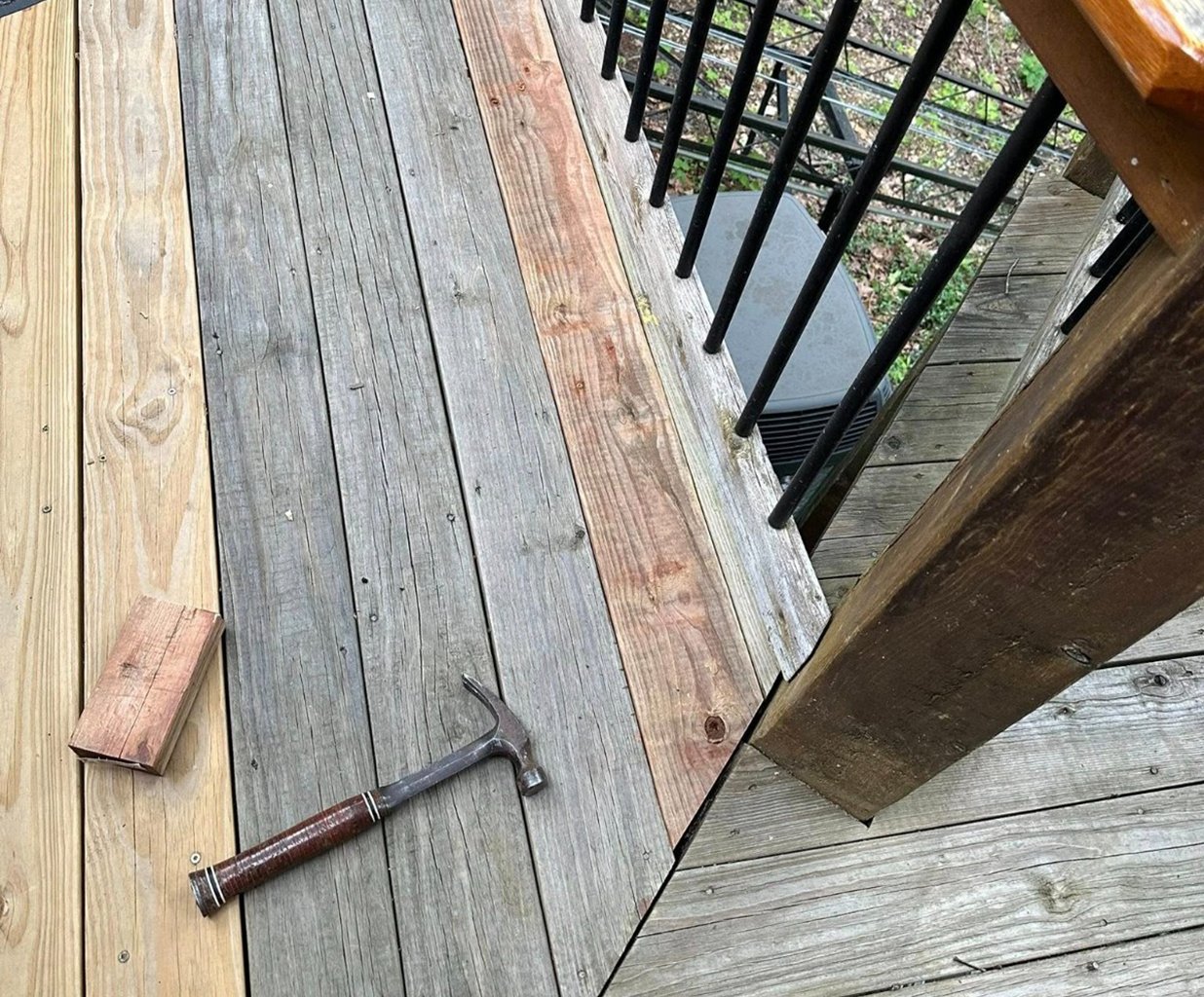
The Damage That Happens While Nobody Is Watching
The October closing ritual at Lake of the Ozarks is familiar to seasonal property owners across the region. The boat comes out of the water. The dock gets tied up or pulled. The furniture goes inside. The utilities get winterized. The property gets locked and left to whatever Missouri delivers through November, December, January, February, and March.
What most homeowners don’t think about during that closing ritual is what the five-month absence means for the dock boards, the deck surfaces, and the concrete walkways and driveways that will be waiting for them when they return in spring. Because Missouri’s winters — specifically the freeze-thaw cycling that’s characteristic of this latitude — are doing active, measurable work on every wood and concrete surface on the property through every one of those absent months.
Freeze-thaw damage isn’t dramatic. It doesn’t announce itself the way a storm damage or a roof failure does. It works incrementally — a micro-fracture here, a slight widening of a board check there, a small increase in concrete pore size at each cycle. The effects accumulate invisibly through a closed season and reveal themselves at spring opening as soft board sections, wider cracks, spalled concrete surfaces, and structural changes that weren’t there — or weren’t as advanced — at the fall closing.
My Handyman LOZ has been maintaining Lake of the Ozarks properties through seasonal cycles since 1992. This article explains exactly what freeze-thaw cycling does inside wood and concrete, why lake properties are more vulnerable than inland properties to this specific damage mechanism, and what the fall and spring maintenance practices that limit that damage look like.
**📞 Call (573) 217-6060 | Text Photos for a Fast Estimate**
The Physics of Freeze-Thaw Damage — What’s Happening Inside the Material
The mechanism that makes freeze-thaw cycling damaging to porous materials is straightforward physics — but understanding it clearly explains why moisture management before winter is such a direct determinant of how much freeze-thaw damage accumulates.
Water Expands When It Freezes
Water is unusual among common substances in that its solid form — ice — is less dense than its liquid form. When water freezes, it expands by approximately nine percent volumetrically. This nine percent expansion is what makes freeze-thaw damage possible.
When liquid water is present inside the pore structure of a material — inside the microscopic channels in concrete, or inside the cell wall structure of wood — and that water freezes, the expansion creates internal pressure against the pore walls. If the internal expansion pressure exceeds the material’s tensile strength at the pore wall, the pore wall cracks. The crack may be microscopic after the first cycle. But after multiple cycles — each one expanding the water, cracking the pore wall, allowing more water to infiltrate the slightly larger crack, freezing again, and expanding further — the crack grows progressively.
**In concrete,** this progressive cracking process produces surface spalling (the flaking and pitting of the surface layer), crack widening at joints and stress points, and in advanced cases, delamination of surface layers from the substrate beneath.
**In wood,** the cells that carry water through the wood fiber structure are the locations where freeze-thaw expansion occurs. Wood fiber that has absorbed significant moisture before winter experiences repeated expansion pressure on the cell walls, creating micro-fractures that make the wood more moisture-absorbent in subsequent seasons — which accelerates the cycle further.
The Critical Variable: How Much Moisture Was Present Before Freezing
The amount of freeze-thaw damage any given freeze-thaw cycle produces is directly proportional to how much moisture was present in the material when temperatures dropped below freezing. Less moisture = less expansion = less internal pressure = less damage per cycle.
This is the variable that fall maintenance directly controls. A dock board that enters winter fully saturated with the season’s moisture load experiences dramatically more internal pressure through each freeze-thaw cycle than a dock board that entered winter after a professional cleaning and staining that removed biological growth and applied a moisture-limiting protective coating.
A concrete walkway that enters winter with biological growth occupying its pore structure — growth that holds moisture against the concrete surface and contributes to higher average pore moisture content — experiences more aggressive freeze-thaw damage than the same walkway that was professionally cleaned, caulked, and sealed before winter closed.
The fall maintenance services that remove biological load, address caulking failures, and apply protective coatings are moisture management decisions as much as appearance decisions — and their value is measured in the winter damage they prevent as much as the appearance improvement they produce.
What Freeze-Thaw Damage Looks Like on Dock and Deck Wood
Wood at Lake of the Ozarks docks and decks enters winter carrying moisture from a season of lake humidity, wave spray, swimmer activity, rain, and morning dew. The amount of moisture it carries at closing depends significantly on how well the surface has been maintained and protected through the season — but at virtually every lake property, dock and deck wood is entering Missouri winters with more moisture content than protected or well-drained wood would carry.
The Freeze-Thaw Progression in Dock and Deck Boards
**First season of exposure on unprotected wood:** Early freeze-thaw damage is microscopic — the expansion of moisture in wood cells creates micro-fractures in the cell wall structure that aren’t visible to the naked eye. The wood appears unchanged at spring opening but has begun the process of becoming more moisture-absorbent through the cell wall fracturing.
**Second and third seasons:** Micro-fractures have accumulated to the point where visible surface checking begins to appear — the fine cracks running along the grain that characterize freeze-thaw stressed wood. Surface checking is the visible evidence that the internal fracturing process has reached the level where individual cracks are joining and expanding to detectable size. At this stage, the checking creates direct channels for moisture infiltration into the structural fiber below the surface layer, accelerating the biological growth and structural degradation that follows.
**Four or more seasons:** Surface checking has widened to deep cracking in the worst-affected boards. The increased moisture infiltration through these cracks has allowed biological growth to establish at deeper levels. Combined with the mold-driven structural degradation that sustained biological growth produces, the freeze-thaw damaged boards that were showing surface checking two seasons ago may now be showing the soft, compressible response to foot pressure that indicates structural fiber compromise.
**The boards most vulnerable to freeze-thaw damage:**
The boards most vulnerable to early freeze-thaw damage are those with the highest moisture content entering winter — which at Lake of the Ozarks consistently means:
- Boards with established biological growth that holds moisture against the surface
- Boards in board gaps where organic debris accumulation retains moisture
- Boards at the waterline where wave spray and water contact is most frequent
- Boards on north-facing dock sections that dry most slowly between wet events
- Boards that have surface checking from previous seasons, which admit more moisture
All of these are boards that fall cleaning — removing the biological and organic moisture retention — and fall staining — applying protective coating — directly reduce the moisture content of before winter arrives.
Railing Posts and Structural Connections
Railing posts and structural connection hardware experience freeze-thaw effects at their moisture-contact points — which at Lake of the Ozarks typically means:
**Post bases** at the connection to the dock frame accumulate organic debris and moisture from the deck surface above and from the lake humidity below. Post bases that enter winter with compromised wood fiber — from mold damage or from previous freeze-thaw cycles — experience more aggressive freeze-thaw expansion at the base connection than post bases on sound wood. This advances the rot cycle at the post base and accelerates the loosening of the post-to-frame connection.
**Fastener hardware** — the screws, bolts, and lag hardware that hold dock frames together — cycles through freeze and thaw with the differential expansion and contraction that different materials (metal hardware, wood fiber, possibly composite material) experience at different rates. This differential cycling can slowly work fasteners loose over multiple winters, particularly at structural connections where the hardware has already experienced some corrosion-driven dimensional change.
What Freeze-Thaw Damage Looks Like on Concrete
The concrete at Lake of the Ozarks properties — driveways, walkways, dock approaches, retaining walls — is exposed to Missouri’s full freeze-thaw cycle through every winter, and the damage it accumulates is a direct function of how much moisture was in the concrete pore structure when temperatures dropped.
Surface Spalling
Surface spalling — the progressive flaking and pitting of the concrete surface layer — is the most visible freeze-thaw damage on Lake of the Ozarks concrete. It begins as a slightly pitted, rough texture that’s barely distinguishable from normal surface wear, and progresses to visible flaking of the surface layer in the areas of heaviest biological growth and moisture accumulation history.
Spalling indicates that the freeze-thaw expansion pressure has exceeded the tensile strength of the surface concrete layer — that micro-fractures have accumulated to the point where sections of surface concrete are separating from the substrate beneath them. Once spalling begins, the exposed aggregate and increased surface roughness creates a surface that’s more hospitable to biological growth, more moisture-retentive, and more vulnerable to the next season’s freeze-thaw cycle — producing a compounding damage progression.
Joint and Crack Widening
Concrete joints — the deliberate breaks between slabs that allow thermal expansion and contraction — and existing surface cracks are the locations where freeze-thaw damage concentrates most aggressively. Moisture that infiltrates through an existing crack or joint freezes and expands, widening the crack by the amount of expansion. Over multiple cycles, the crack becomes measurably wider — allowing more moisture infiltration, more expansion, and progressive crack widening.
On Lake of the Ozarks properties where the original joint caulking has deteriorated — cracked, pulled away from the joint faces, or simply aged past its service life — those joints are open pathways for winter moisture infiltration and significant freeze-thaw damage at the joint edges and in the concrete immediately adjacent to the joint.
**Caulking before winter** — addressing deteriorated joint material and open cracks before freeze-thaw season begins — directly prevents the moisture infiltration pathway that produces joint widening and joint-edge spalling. This is the fall maintenance service that most directly translates to reduced concrete repair costs in subsequent seasons.
The Sealing Connection
Sealed concrete has significantly lower pore moisture content entering winter than unsealed concrete — because the sealer has occupied the pore structure that would otherwise fill with the lake humidity and biological moisture that accumulates through the warm season.
Lower pore moisture content means less freeze-thaw expansion per cycle. Less expansion means less internal pressure per cycle. Less pressure means fewer micro-fractures per cycle and a longer timeline to visible surface damage. The concrete sealing that’s applied in fall before freeze-thaw season begins is delivering its highest-value protective function through winter — the moisture limitation that reduces internal pressure through every freeze event.
Why Lake of the Ozarks Properties Are More Vulnerable Than Inland Properties
Lake homeowners who’ve owned property in other parts of Missouri are sometimes surprised by how much more aggressive freeze-thaw damage is on their lake property than on comparable structures at their primary residence. The explanation is moisture content — specifically the significantly higher moisture content that lake-adjacent materials carry into winter compared to drier inland locations.
**Lake humidity elevates baseline moisture content.** Throughout the warm season, the elevated relative humidity from the lake surface keeps wood and concrete at higher baseline moisture levels than the same materials would maintain at an inland location. Wood that’s been equilibrating to 70-80 percent relative humidity for six months enters winter with higher equilibrium moisture content than wood that’s been at 50-60 percent relative humidity for the same period. The freeze-thaw damage that accumulates is a direct function of that higher starting moisture content.
**Biological growth holds additional moisture.** Algae and mold that accumulate on dock, deck, and concrete surfaces through the lake season act as moisture-retaining layers — they hold water against the material surface after rain and dew events, extending the period during which the surface is at elevated moisture content. Materials that close for winter with established biological growth surface loading carry significantly more moisture into freeze-thaw season than materials that close clean.
**Fall cleaning directly reduces winter damage.** The fall closing clean — professional cleaning of dock surfaces, deck surfaces, and concrete areas before winter — removes the biological moisture-retaining load that would otherwise hold additional moisture in the material through freeze-thaw season. This isn’t just about appearance at closing; it’s about reducing the moisture content that’s present in the material when temperatures drop. The fall cleaning that reduces winter freeze-thaw damage is one of the clearest preventive maintenance investments available for Lake of the Ozarks properties.
The Fall Maintenance Checklist That Limits Freeze-Thaw Damage
The fall closing maintenance services that most directly limit freeze-thaw damage through winter are:
**Dock and deck professional cleaning** — removes biological growth and organic debris that hold moisture against wood surfaces through winter. Cleaned surfaces enter winter with lower moisture content than uncleaned surfaces, reducing the internal expansion pressure that each freeze-thaw cycle generates.
**Deck and dock staining** — protective stain applied to cleaned, dried wood limits moisture absorption through winter by occupying the wood pore structure that would otherwise fill with winter moisture. Staining in fall before freeze-thaw season is the moisture management decision that most directly reduces wood freeze-thaw damage.
**Concrete caulking** — addressing failed joint material and open cracks before freeze-thaw season prevents the moisture infiltration through those locations that drives concrete joint widening and joint-edge spalling.
**Concrete sealing** — applied to cleaned, caulked concrete before freeze-thaw season, sealing occupies the pore structure that would otherwise fill with moisture and undergo nine percent expansion through each freeze-thaw cycle.
**Structural inspection** — fall closing is the right time for a systematic structural inspection of dock and deck before winter, because boards and structural members that are already compromised will experience more aggressive freeze-thaw damage than sound structures. Identifying and addressing soft boards before winter prevents the further advancement that an unaddressed freeze-thaw season would produce.
Spring Opening — Reading the Freeze-Thaw Damage Record
Spring opening at a Lake of the Ozarks property is, in part, a reading of what winter’s freeze-thaw cycling has done since October. The specific changes from fall closing to spring opening tell the story of how much moisture was present through the winter and where the most aggressive freeze-thaw activity occurred.
**New surface checking on dock or deck boards** that wasn’t present at fall closing indicates boards that carried significant moisture through winter. These boards deserve close assessment — the new checking has opened moisture infiltration pathways that will advance biological growth and structural degradation more aggressively through the upcoming season than they would have from the previous season’s baseline.
**Wider concrete cracks or joints** than were present at fall closing indicate active freeze-thaw expansion at those locations through winter. These locations need caulking before spring cleaning and sealing to prevent another winter’s expansion cycle from widening them further.
**New soft spots in dock boards** — boards that pass the pressing test at fall closing but show structural softness at spring opening — have experienced enough freeze-thaw damage through the winter to cross the structural failure threshold. These boards need replacement before the season begins.
**Increased surface roughness on concrete** that was smooth at fall closing indicates surface spalling has begun — the freeze-thaw expansion has started separating surface concrete from the substrate. This is the right time to clean, caulk, and seal to interrupt the cycle before it advances further.
My Handyman LOZ performs spring opening inspections that specifically assess the freeze-thaw damage record since fall closing — giving Lake of the Ozarks homeowners and vacation rental owners a clear picture of what winter produced and what the spring maintenance scope needs to address.
Frequently Asked Questions — Freeze-Thaw Damage at Lake of the Ozarks
01. How much damage does a single freeze-thaw cycle actually do to dock and deck wood?**
A single freeze-thaw cycle on wood that’s carrying normal moisture content from a lake season produces micro-fractures that are individually small but cumulative — the damage from one cycle is invisible, but fifteen to twenty cycles through a Missouri winter accumulates to visible surface checking, widened board gaps, and measurably increased moisture absorption in subsequent seasons. The total damage depends on how many cycles occur and how much moisture was present in the wood before winter — which is directly managed by fall cleaning and staining.
02. Does protective staining actually help with freeze-thaw damage, or is it just for appearance?**
Protective staining substantially reduces freeze-thaw damage by limiting the moisture that enters wood fiber through winter. The stain occupies the pore structure that would otherwise fill with moisture — lower moisture content means less freeze-thaw expansion per cycle, which means less internal pressure and fewer and smaller micro-fractures per cycle. A well-stained surface entering winter will show significantly less spring surface checking than an unstained surface with the same exposure history.
03. Which type of concrete damage from freeze-thaw is the most expensive to repair?**
Joint widening that progresses to the point of undermining the structural joint — where the joint edges are significantly spalled and the joint geometry has changed enough that it no longer accommodates slab movement properly — can require concrete joint reconstruction rather than simple caulking. Surface spalling that reaches full delamination of a surface layer may require resurfacing or slab replacement in severely affected areas. Both of these advanced outcomes are preventable with caulking and sealing before freeze-thaw season begins — making prevention cost dramatically less than remediation.
04. Should I seal concrete in the fall or the spring for freeze-thaw protection?**
Fall sealing provides the most direct freeze-thaw protection because it limits the moisture that enters the concrete pore structure before the first freeze event. Spring sealing provides UV and biological growth protection for the upcoming season. Both have value — fall sealing is specifically the right timing if the goal is reducing winter freeze-thaw damage, while spring sealing is appropriate if fall sealing wasn’t completed and the goal is protecting through the upcoming warm season.
05. What spring conditions indicate that my dock had significant freeze-thaw damage through winter?**
New surface checking that wasn’t present at fall closing, boards that feel different underfoot than they did before closing, wider visible board gaps than at fall close, and any new soft spots in boards that were firm at closing all indicate freeze-thaw advancement through winter. My Handyman LOZ spring opening inspections specifically compare current condition to previous service documentation to identify freeze-thaw changes since fall closing.
06. Is freeze-thaw damage reversible once it has occurred?**
The structural damage from freeze-thaw cycling — micro-fractures, cell wall compromise, increased moisture absorption — is not reversible in the affected material. What is controllable is preventing further advancement through protective measures and replacing structural components that have reached failure threshold. The goal of fall maintenance isn’t to undo previous freeze-thaw damage; it’s to limit how much additional damage the upcoming winter produces.
Every Missouri Winter Is Working on Your Lake Property. Fall Maintenance Is Your Response.
The freeze-thaw cycles that Lake of the Ozarks properties experience through every Missouri winter are a physical inevitability — they’re going to happen, and they’re going to put internal expansion pressure on every moisture-carrying pore in your dock boards, deck boards, and concrete surfaces. What fall maintenance does is reduce the moisture content those materials carry into winter — which directly reduces how much damage each cycle produces.
My Handyman LOZ has been helping Lake of the Ozarks homeowners close their properties correctly for the winter season since 1992. Fall cleaning, protective staining, concrete caulking and sealing, and structural inspection before closing are the maintenance decisions that determine how much spring opening reveals and how much spring repair requires. We make that fall maintenance as efficient and complete as possible — so winter does less work, and spring costs less to address.
**📞 Call (573) 217-6060**
**📱 Text Photos for a Fast Estimate**
**🌐 Schedule Your Fall Closing Maintenance — Contact Page**
*Serving Lake Ozark, Osage Beach, Camdenton, Sunrise Beach, Laurie, Four Seasons, Porto Cima, Linn Creek, Eldon, and the surrounding Lake of the Ozarks communities since 1992.*+