
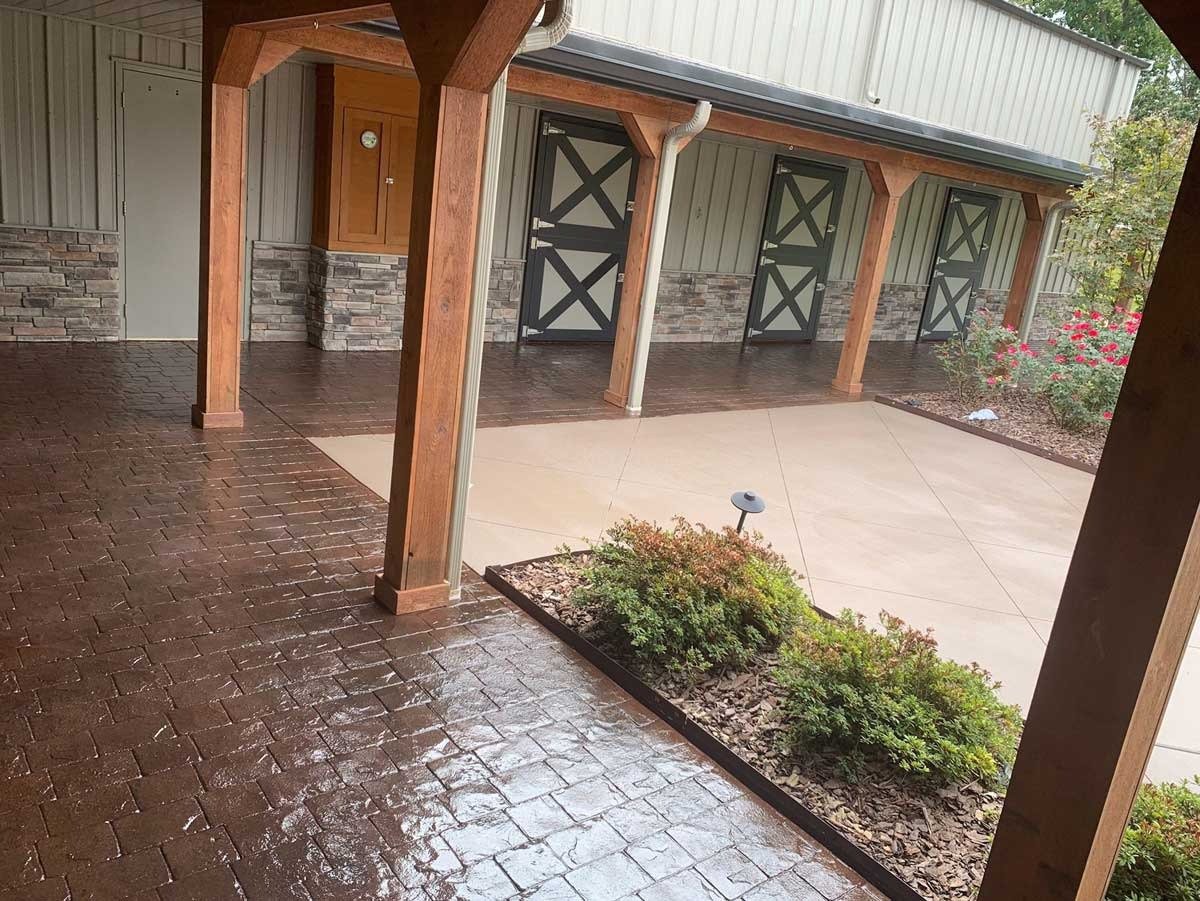
The Surface Nobody Thinks About Until Something Goes Wrong
There’s a predictable pattern to how lake homeowners discover that their concrete needed attention. It usually starts with something minor — a crack they’ve noticed widening through a couple of winters, a dark stain that pressure washing can’t fully remove, a section of the driveway that feels rougher and more porous than it used to. And somewhere in that discovery is the realization that whatever has been happening to the concrete has been happening for a while, quietly, without drama, while the dock and the deck were getting all the maintenance attention.
Concrete doesn’t fail dramatically. It deteriorates gradually — absorbing moisture, supporting biological growth, cracking from freeze-thaw expansion, spalling from the surface inward — until what was a smooth, clean, functional surface is rough, stained, cracked, and in some cases structurally compromised. The process that produces that outcome is predictable, preventable, and consistently faster at Lake of the Ozarks than most homeowners expect.
My Handyman LOZ has been cleaning, sealing, and maintaining concrete surfaces on lake properties throughout Lake Ozark, Osage Beach, Camdenton, Sunrise Beach, Laurie, Four Seasons, Porto Cima, Linn Creek, Eldon, and the surrounding communities since 1992. The concrete on a lake property — driveways, walkways, dock approaches, retaining walls, boat ramp areas — faces a maintenance environment that rewards consistent protection and punishes neglect in very specific ways. This article explains exactly why.
**📞 Call (573) 217-6060 | Text Photos for a Fast Estimate**
What Makes Lake of the Ozarks So Hard on Concrete
Concrete is not impervious. Despite its appearance of permanence, concrete is a porous material — full of microscopic capillary channels that absorb water, support biological growth, and provide the pathways for the freeze-thaw cycling that progressively damages concrete from the inside. At Lake of the Ozarks, several converging factors make those processes more aggressive than they would be at a property in a drier or less biologically active location.
Persistent Moisture and Humidity
The proximity to the lake means concrete surfaces on lakefront properties stay wetter for longer after rain, dew, and humidity events than comparable surfaces inland. The concrete in the shaded sections of a Camdenton driveway or the walkway approach to a Sunrise Beach dock may stay damp for days at a time during peak lake season — continuously absorbing moisture into its pore structure rather than cycling through the wet-dry pattern that helps self-limit biological growth and moisture damage on drier-climate concrete.
Missouri’s Freeze-Thaw Cycles
Missouri winters deliver the freeze-thaw cycling that is the primary physical damage mechanism for concrete at Lake of the Ozarks. Here’s how it works: moisture absorbed into concrete’s pore structure freezes when temperatures drop. Water expands approximately nine percent when it transitions from liquid to ice. That nine percent expansion exerts internal pressure on concrete’s pore walls — pressure that the concrete resists up to a point, and beyond that point accommodates through micro-fractures.
Over multiple freeze-thaw cycles through a Missouri winter, those micro-fractures expand, connect, and eventually produce the surface spalling and cracking that characterizes freeze-thaw damaged concrete. The more moisture the concrete absorbed before winter arrived — which at a lake property in a humid environment is typically a significant amount — the more expansion force the freeze-thaw cycle generates.
Concrete sealing limits moisture absorption. Less moisture absorbed before winter means less freeze-thaw expansion force through the freeze-thaw cycles. Sealed concrete doesn’t eliminate freeze-thaw damage risk — it substantially reduces the moisture content that makes freeze-thaw damage aggressive.
Algae and Biological Growth
Concrete in the humid, organically rich lake environment supports algae and mold growth on its surface in the same way dock boards and deck surfaces do — with two significant differences. First, algae on concrete creates a genuine slip hazard that’s as dangerous as algae on dock boards, but on surfaces where guests and family members are often carrying luggage, groceries, or other items that occupy their hands and limit their fall-response ability. Second, biological growth on concrete doesn’t just sit on the surface — it occupies concrete’s pore structure and produces organic acids that chemically attack the cement paste binding concrete’s aggregate particles together.
The surface pitting and progressive roughening that characterizes algae-damaged concrete isn’t just aesthetic deterioration. It’s the result of the cement paste binding the aggregate being chemically eroded by biological acid production — a process that deepens the concrete’s effective pore size, accelerates moisture absorption, and creates a rougher surface that’s even more hospitable to biological growth in the next season.
UV Exposure and Thermal Cycling
South and west-facing concrete surfaces at Lake of the Ozarks properties face intense afternoon UV that drives surface heating and cooling cycles that stress the concrete’s surface layer. Combined with the moisture conditions and freeze-thaw dynamics described above, these thermal cycling stresses contribute to the surface map-cracking and spalling that appears on unprotected lakefront concrete.
Why Concrete Sealing Is the Right Response to These Conditions
Concrete sealing doesn’t eliminate the environmental pressures that lake properties put on concrete surfaces. What it does is place a protective barrier between those pressures and the concrete substrate — reducing moisture infiltration, slowing biological growth establishment, limiting the freeze-thaw damage cycle, and protecting the cement paste from the biological acid production that biological growth on unsealed concrete produces.
The specific benefits are practical and measurable:
**Moisture resistance** — sealed concrete absorbs dramatically less water than unsealed concrete. The water beads and runs off rather than infiltrating the pore structure. Less water in the concrete means less freeze-thaw expansion force, slower biological growth establishment, and a cleaner surface appearance maintained for longer between cleaning services.
**Biological growth resistance** — sealed concrete surfaces are significantly less hospitable to algae and mold establishment than unsealed surfaces. The sealed pore structure provides less foothold for biological organisms than open, absorptive concrete. On Lake of the Ozarks properties where algae on concrete walkways is a genuine slip hazard, the biological growth resistance that sealing provides is a direct safety benefit alongside its maintenance advantage.
**Stain resistance** — sealed concrete resists the organic staining from leaves, pollen, vehicle fluids, and general outdoor organic matter that accumulates on lake property concrete surfaces. Staining that would penetrate and become permanent on unsealed concrete sits on the sealed surface and cleans more completely with professional pressure washing. The sealed concrete that’s cleaned annually looks significantly better than unsealed concrete cleaned at the same frequency because the staining hasn’t permanently penetrated the substrate.
**Freeze-thaw protection** — as described above, reduced moisture absorption translates directly to reduced freeze-thaw expansion force. Sealed concrete at a Lake of the Ozarks property goes through Missouri winters with less moisture-driven internal stress than unsealed concrete — producing less surface spalling, slower crack development, and a longer functional life between repair interventions.
**Enhanced appearance longevity** — sealed concrete retains the appearance of recently cleaned concrete for significantly longer than unsealed concrete under the same conditions. For vacation rental properties where driveway and walkway appearance is part of the arrival experience that shapes guest first impressions, this appearance longevity is a direct asset.
Concrete Caulking — The Step That Has to Come Before Sealing
Before any sealing work can deliver its full protective value, existing cracks and joints in the concrete need to be addressed. This is the step that’s most commonly skipped — and the skip that most consistently reduces the value of a sealing application.
Concrete moves. Thermal expansion and contraction through seasonal temperature cycles creates dimensional movement in concrete slabs and sections. This movement is why properly installed concrete has expansion joints — the deliberately created gaps between sections that allow each section to move independently without transferring stress to adjacent sections.
When those joints deteriorate — when the original joint material cracks, crumbles, or pulls away from the joint edges — they become open pathways for water infiltration directly into the concrete substrate and the base material beneath it. Water that enters through a failed joint bypasses the surface sealing entirely, reaching the concrete-to-base interface where freeze-thaw cycling does its most structurally consequential work.
Concrete caulking addresses these failed joints before sealing — applying flexible, waterproof joint filler that restores the joint’s waterproofing function while allowing the dimensional movement the joint was designed to accommodate. Without caulking failed joints before sealing, the sealer creates a waterproof surface while the joints remain open pathways for water to reach exactly the areas where damage is most consequential.
On Lake of the Ozarks properties with older concrete that has developed significant joint deterioration and surface cracking, a professional concrete cleaning, caulking, and sealing sequence delivers dramatically better long-term results than sealing alone — because the complete sequence addresses both the surface moisture infiltration and the joint infiltration that together determine how aggressively the concrete ages.
The Concrete Surfaces on a Lake Property That Need Sealing
Not all concrete on a lake property faces the same conditions or presents the same sealing priority. Here’s a practical breakdown of the specific surfaces on most Lake of the Ozarks properties and why sealing matters for each:
Driveways and Parking Areas
The driveway is the arrival sequence for every visit to the property — guests, family, vendors, and the property owner’s own daily return. Stained, cracking, algae-streaked concrete in the approach area sets a maintenance tone before anyone has reached the door.
Driveways at lake properties face vehicle traffic loading, fluid staining from vehicles, the full force of Missouri’s freeze-thaw cycles, and the organic staining and algae growth that lakeside humidity produces. Professional pressure washing restores the surface appearance. Sealing after cleaning protects that restored appearance, resists future staining, and significantly reduces the moisture absorption that drives freeze-thaw damage through the next winter.
Walkways and Approach Paths
The walkway from the parking area to the front door, from the house to the dock, and between outdoor living areas carries foot traffic every single day the property is occupied. On a vacation rental property, that foot traffic includes guests who are unfamiliar with the surface conditions, often carrying items, often arriving or departing in weather conditions that make surfaces wet.
Algae on a concrete walkway is a genuine slip hazard — producing the same near-zero friction conditions that algae on dock boards creates. The guest who slips on a concrete walkway covered in algae film has the same injury exposure as the guest who slips on an algae-covered dock. Cleaning removes the immediate hazard. Sealing slows biological growth reestablishment — extending the period before the algae slip hazard returns.
Dock Approach and Ramp Areas
The concrete areas immediately around dock access — the dock approach, boat ramp areas, the transition from yard to dock structure — are among the highest-traffic and highest-moisture concrete surfaces on a lake property. They’re also the surfaces most consistently covered in biological growth from their proximity to the water.
Sealing these areas provides the biological growth resistance and moisture protection that dock-adjacent concrete specifically needs — where the combination of constant water contact and heavy foot traffic creates conditions that unsealed concrete deteriorates under faster than any other lake property surface.
Retaining Walls
Retaining walls on Lake of the Ozarks hillside and lakefront lots manage grade changes that are fundamental to how the property functions. Concrete block and poured concrete retaining walls face moisture from the retained soil above and the lake humidity below — making moisture infiltration a persistent structural concern alongside the appearance issues biological growth creates on wall faces.
Professional cleaning removes biological growth from retaining wall faces. Appropriate sealer applied to clean concrete block or masonry reduces moisture infiltration into the wall structure and slows the biological growth cycle that relentlessly re-establishes on moist, organically loaded wall surfaces.
The Cleaning-First Requirement — Why Sealing Over Dirty Concrete Fails
Concrete sealing applied over a surface that hasn’t been professionally cleaned is one of the most common and most wasteful concrete maintenance mistakes at Lake of the Ozarks.
Sealer bonds to the concrete surface — which means it needs to bond to clean concrete, not to the organic staining, algae film, mold, and general contamination that accumulates on lake property concrete between cleanings. Sealer applied over contaminated concrete bonds to the contamination layer. The result is a sealed surface that looks clean immediately after application and degrades rapidly — the sealer peeling or flaking as the contamination layer it bonded to fails beneath it, or simply providing reduced moisture protection because the bond to the actual concrete surface was incomplete.
Professional pressure washing removes embedded staining, organic growth, and surface contamination down to clean concrete. Allowed to dry fully — typically 24 to 48 hours in good conditions — the cleaned concrete provides the surface chemistry that sealer bonds to correctly. Applied to a properly cleaned and dried surface, quality concrete sealer bonds at full adhesion and delivers its protective properties through multiple seasons rather than failing within the first.
The sequence — clean, dry, seal — is the sequence that produces results worth the investment. Skipping or shortening any step produces a result that fails faster than the property owner has any reason to expect.
How Often Should Lake of the Ozarks Concrete Be Cleaned and Sealed?
The right maintenance frequency depends on the specific surface, its exposure conditions, and the sealer type applied. General guidance:
**Annual professional pressure washing** of all concrete surfaces — driveways, walkways, dock approaches — removes the biological growth and organic staining that accumulates through the lake season and prevents the biological acid production that chemically attacks unsealed and aging-sealed concrete.
**Concrete sealing every two to four years** depending on traffic, UV exposure, and the specific sealer product applied. High-traffic surfaces like driveways and dock approach areas may need resealing every two years. Lower-traffic walkways and retaining walls may hold a quality sealer for three to four years before the protective layer has worn to the point where reapplication is productive.
**Concrete caulking as needed** when joint material shows cracking, separation, or deterioration. On older Lake of the Ozarks properties where the original joint material has seen many Missouri winters, annual inspection of joint condition during the cleaning service determines when caulking is warranted.
**Spring is the ideal window** for concrete cleaning and sealing at Lake of the Ozarks — after winter’s freeze-thaw cycling has been completed, before the season’s biological growth cycle begins, and with the dry spring weather that supports proper sealer application and curing.
The Vacation Rental Concrete Consideration
For STR investors managing vacation rental properties at Lake Ozark, Osage Beach, Four Seasons, and throughout the lake, concrete condition carries specific revenue implications that private homeowners don’t face in the same way.
The arrival sequence — from vehicle to door — is the first physical experience guests have of the property. Clean, bright, sealed concrete communicates property maintenance standards before a guest has turned a doorknob. Stained, cracking, algae-covered concrete communicates the opposite — and that communication carries through the entire stay.
More practically: an algae-covered concrete walkway on a vacation rental property where a guest slips and falls creates the same liability exposure that a slippery dock creates. The property owner’s maintenance record — including documented concrete cleaning and sealing services — is relevant context in any post-incident discussion of whether reasonable care was exercised.
My Handyman LOZ works with Lake of the Ozarks vacation rental owners on seasonal concrete maintenance programs that coordinate cleaning and sealing around the booking calendar — completing concrete work in service windows between guest arrivals so the property is always presenting its best and the owner always has a documented maintenance record.
Frequently Asked Questions — Concrete Sealing at Lake of the Ozarks
01. Why does concrete at Lake of the Ozarks need sealing more urgently than concrete elsewhere?
Lake of the Ozarks concrete faces a combination of factors that aren’t present at most inland Missouri properties simultaneously: persistent humidity from proximity to the water, heavy biological growth from the warm lake environment, and Missouri’s full freeze-thaw cycling through winter. Each factor individually accelerates concrete deterioration. All three operating together on the same surface makes concrete sealing a more urgent maintenance decision at the lake than in drier or less biologically active locations.
02. Can I seal concrete myself or do I need a professional?
Consumer concrete sealers are available at home improvement stores and can be applied by homeowners. The limiting factor is surface preparation — professional pressure washing that cleans concrete to the depth required for proper sealer adhesion is difficult to replicate with consumer equipment. Sealer applied over inadequately cleaned concrete underperforms significantly. The professional cleaning that precedes sealing is where most of the value in a professional sealing service comes from.
03. How long does concrete sealing last at a lake property?
Quality penetrating concrete sealer on a properly cleaned and prepared surface typically lasts two to four years at a Lake of the Ozarks property, depending on the specific surface, traffic level, UV exposure, and the sealer product applied. High-traffic driveways at the lower end; lower-traffic walkways and walls at the higher end. Annual professional cleaning maintains the sealed surface and makes each resealing application more effective by ensuring the sealer bonds to clean concrete.
04. Does concrete sealing make the surface slippery?
Quality concrete sealers appropriate for exterior horizontal surfaces — driveways, walkways, dock approaches — are formulated to maintain slip resistance. Film-forming sealers applied incorrectly or in excess can create slippery surfaces, which is one reason why professional application with appropriate product selection matters. Penetrating sealers that absorb into the concrete pore structure rather than forming a surface film don’t create slip hazard concerns.
05. Do cracks in my concrete need to be fixed before sealing?
Surface sealing over existing cracks provides minimal benefit at the crack location — the sealer can bridge hairline cracks but doesn’t structurally repair them, and water infiltrating through unsealed cracks bypasses the sealed surface entirely. Concrete caulking of significant cracks and joints before sealing is the approach that provides waterproofing protection at both the surface and the crack/joint locations. My Handyman LOZ assesses crack and joint condition during concrete cleaning and advises on what caulking is warranted before sealing proceeds.
06. What’s the best time of year to seal concrete at a Lake of the Ozarks property?
Spring — after freeze-thaw cycling has completed for the season and before the biological growth season begins — is ideal. Sealer requires adequate temperature conditions for proper curing, and spring weather at Lake of the Ozarks consistently provides the above-50°F temperatures and low moisture conditions that most concrete sealers specify for application. Fall is the second-best window for properties that miss the spring opportunity.
Protect What You’ve Built Before Another Winter Gets to It
The concrete on your Lake of the Ozarks property has been absorbing moisture, supporting biological growth, and cycling through freeze-thaw stress every season it’s gone without professional cleaning and sealing. The deterioration that process produces is gradual, quiet, and consistently more advanced than it looks on the surface.
My Handyman LOZ has been cleaning, caulking, and sealing concrete on lake properties throughout the region since 1992. We clean to the depth that sealer adhesion requires, address joint and crack conditions before sealing, and apply quality sealers appropriate for the specific surfaces and conditions at your property.
Don’t wait for the spalling and cracking to tell you the concrete needed attention sooner. Spring is the right window — and the right time to get on the schedule.
**📞 Call (573) 217-6060**
**📱 Text Photos for a Fast Estimate**
**🌐 Schedule Your Concrete Cleaning and Sealing — Contact Page**
*Serving Lake Ozark, Osage Beach, Camdenton, Sunrise Beach, Laurie, Four Seasons, Porto Cima, Linn Creek, Eldon, and the surrounding Lake of the Ozarks communities since 1992.*