
The Window Between Winter and Memorial Day Is Shorter Than You Think
Every spring, the same thing happens at Lake of the Ozarks. Homeowners and vacation rental owners across Lake Ozark, Osage Beach, Camdenton, Sunrise Beach, Laurie, Four Seasons, and every community in between make their way back to the lake after months away — and they find a property that’s had a Missouri winter all to itself.
The dock that looked acceptable at the October closing is covered in algae and mold. The deck boards that were merely weathered are now soft in the corners. The concrete walkway to the water is slick with the biological film that grew uninterrupted through the damp spring. And Memorial Day weekend — the unofficial start of the lake season, the moment when the whole family shows up expecting to jump in a boat and start summer — is closer than it should be given everything that needs to happen first.
Preparing a lake property for summer isn’t a single task. It’s a sequence of connected decisions about what the property needs, what order to address it in, and what the consequences are of getting that sequence wrong. My Handyman LOZ has been working through that sequence on Lake of the Ozarks properties since 1992. This guide covers everything a lake homeowner or vacation rental owner needs to know to arrive at summer with a property that’s ready — not one they’re still catching up on when the guests are already there.
Why Spring Preparation Matters More at the Lake Than Anywhere Else
Lake properties face a maintenance environment that’s fundamentally different from a primary residence in a drier, less biologically active location. The combination of factors that makes the Lake of the Ozarks beautiful — the humidity off the water, the warm Missouri summers, the wooded lots and sheltered coves — creates conditions that work against exterior surfaces continuously and without pause.
**Humidity** at the lake never fully lets go through the warm months. Surfaces that would dry out between rain events at an inland property stay damp here for days at a time. Wood fiber absorbs moisture. Biological growth establishes and advances. Concrete stays wet in the shaded sections that sun never reaches. Five months of winter closure on a Lake Ozark property means five months of uninterrupted biological growth, organic debris settlement, and moisture cycling — with no foot traffic, no cleaning, and no observation to catch what’s changing.
**Freeze-thaw cycling** through a Missouri winter does work inside wood fiber that becomes visible in spring. Water that soaked into deck boards and dock boards in late fall expanded when it froze and contracted when it thawed, repeatedly, until surface checking opened and fiber degradation advanced. The boards that were borderline at closing are often past the borderline by opening.
*Algae and mold** don’t require warm temperatures to advance — they slow down in winter but they don’t stop. Biological growth that established in October has had months to work deeper into wood fiber, wider across concrete surfaces, and further along dock roofs before the property owner returns in spring.
The consequence of all of this is that a lake property’s spring condition is almost always worse than its fall condition — and the amount of work required to restore it to safe, clean, functional use is almost always more than the homeowner expects when they first arrive.
The Spring Preparation Sequence — Why Order Matters
The single most common mistake in lake property spring preparation is addressing things in the wrong order — or in isolation rather than as a connected sequence. The correct order isn’t arbitrary. Each step affects the next one, and getting the sequence right determines whether the work holds through the season.
Step 1: Professional Cleaning Before Anything Else
Every other step in spring preparation depends on knowing the actual condition of the property’s exterior surfaces — and biological growth, organic debris, and winter staining conceal that condition until they’re removed.
A deck board that looks stained but intact may have a soft spot that cleaning reveals. A dock board that’s covered in algae may be structurally sound or may be past the replacement threshold — and only a pressed foot on a cleaned surface tells you which. A concrete walkway that looks dark and neglected may restore completely to clean, bright concrete with a professional pressure wash — or it may have cracking and surface damage that cleaning exposes and sealing needs to address.
Cleaning first — professionally, with the right methods for each surface — is the step that makes every subsequent decision accurate rather than guesswork.
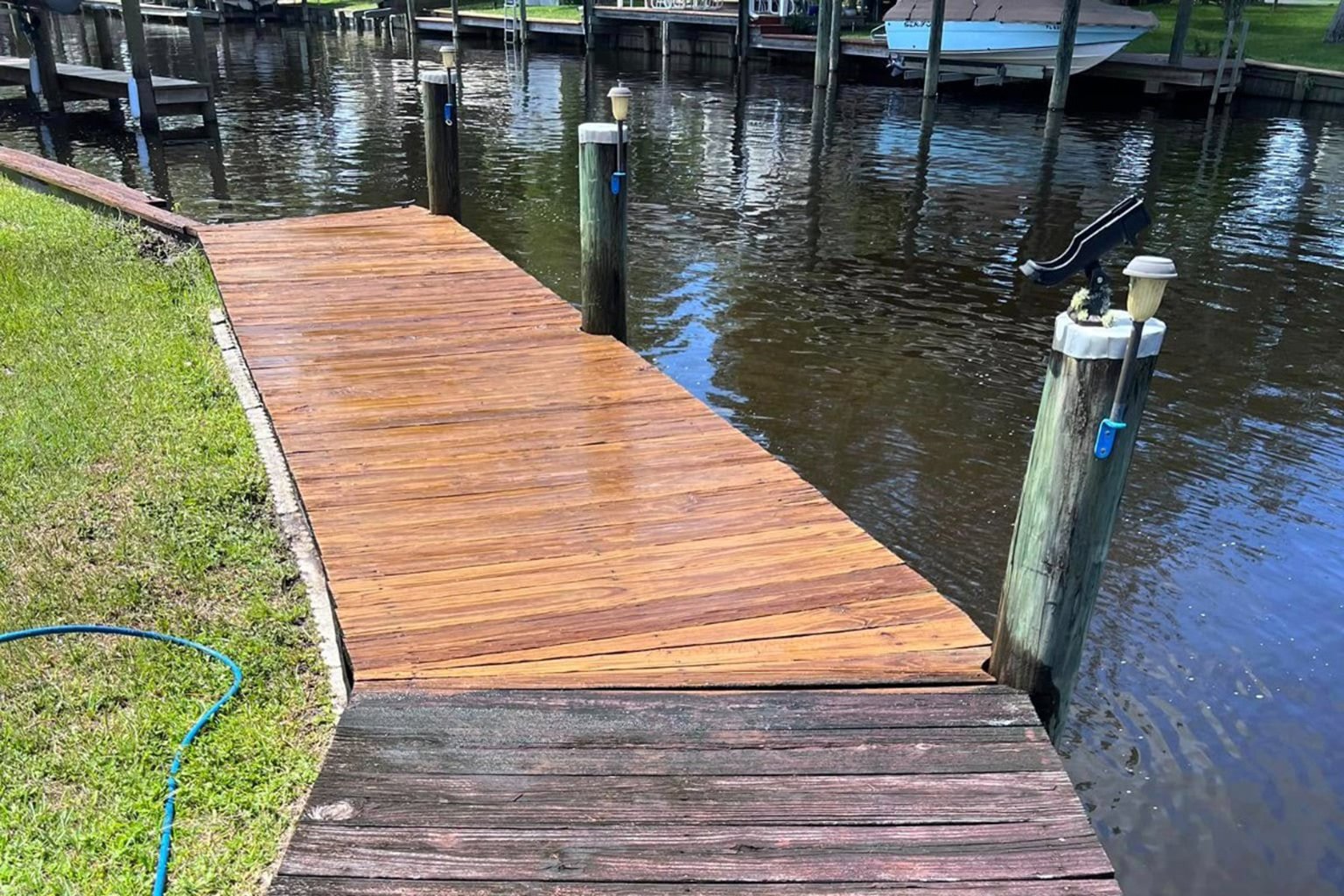
**Dock cleaning** removes the algae, mold, and biofilm from dock boards, railings, dock roofs, and steps that have accumulated through the season and the winter closure. Professional soft washing treats the biofilm layer that drives rapid regrowth, not just the visible surface layer that comes back in weeks after a basic pressure wash.
**Deck cleaning** removes biological growth from deck boards, board gaps, and the organic debris that has settled into the shaded corners and under furniture positions through the off-season. Cleaned deck surfaces are what make accurate structural assessment possible.
**Exterior house washing** removes the mold and mildew from north and west-facing wall surfaces, the oxidation from siding, and the organic staining that makes an otherwise well-maintained home exterior look neglected.
**Concrete cleaning** removes algae film, organic staining, leaf discoloration, and the biological growth that makes concrete walkways and driveways slippery and dark. Cleaned concrete is what gets sealed — and sealing over contaminated concrete doesn’t perform.
Step 2: Structural Assessment After Cleaning
With surfaces clean, structural assessment becomes accurate. This is the step that identifies what needs repair before the season opens — and that prevents the expensive surprise of discovering a structural problem after guests are already using the property.
**Dock structural assessment** covers every board systematically — pressing for softness, checking railing post bases for the rot that advances from below, assessing stair stringers and ramp connections, and inspecting accessible structural members beneath the dock surface where joists and beams carry the load of everyone who walks out there.
**Deck structural assessment** covers board condition, joist and beam integrity at accessible points, railing post base condition, and fastener integrity throughout the deck frame. Deck boards that were borderline in fall are assessed against the condition cleaning has revealed — not the condition surface staining was hiding.
**Dock roof assessment** during cleaning provides access to connection hardware, framing condition at eave and ridge points, and the underside surfaces where biological growth is often more advanced than the top surface reveals.
The goal of the assessment is an honest picture of what needs attention — prioritized by safety first, structural importance second, and appearance third. Railings that move under lateral pressure need repair before anything else. Soft boards that have crossed the structural threshold need replacement before staining. Concrete cracking that creates a tripping hazard needs addressing before sealing.
Step 3: Repairs Before Protective Coatings
Any structural repairs identified during assessment need to be completed before staining or sealing — because protective coatings applied over deteriorated or compromised surfaces don’t fix the underlying problem, they just cover it temporarily while it continues to advance underneath.
**Dock board replacement** for boards that failed the structural assessment — individual boards, sections where deterioration has spread to multiple adjacent boards, or larger rehabilitation where extended deferred maintenance has created widespread soft spots.
**Deck board replacement** following the same assessment-driven scope — only the boards that have actually crossed the replacement threshold, matched as closely as possible to the existing deck surface and installed with fasteners appropriate for the lake environment.
**Railing repairs** — post replacement, connection rehabilitation, and full railing system repair where the assessment identified structural compromise. A railing that wobbles is a safety failure that needs correction before guests are on the property.
**Stair and ramp repairs** — stringer replacement, tread refastening, and base connection repair at the structural points where moisture and load cycling concentrate deterioration.
Repairs before coatings is a sequence rule that My Handyman LOZ holds without exception — because staining over a board that needs replacement, or sealing over concrete that needs caulking first, produces a result that fails and that requires starting the preparation sequence over.
Step 4: Staining, Sealing & Protective Coatings
With surfaces cleaned, assessed, and repaired, protective coatings go on correctly and hold the way they’re supposed to.
**Deck staining** on cleaned, repaired, and fully dried deck wood — penetrating stain with mildewcide that fills wood grain, limits moisture absorption, and creates a surface that resists the biological growth and UV degradation that Lake of the Ozarks conditions deliver continuously. New replacement boards need adequate drying time — typically 30 to 90 days for pressure-treated lumber — before stain is applied. Staining too early produces a surface bond rather than a penetrating bond and the finish fails prematurely.
**Dock staining** using the same preparation and application principles — important particularly on sun-exposed dock surfaces where UV degradation combines with moisture cycling to shorten wood life without protective coating.
**Concrete sealing** on cleaned and caulked concrete surfaces — protecting driveways, walkways, and approach areas from the moisture penetration and organic staining that unprotected concrete accumulates rapidly in a lake environment. Concrete caulking should precede sealing, addressing cracks and joints that let water into the substrate.
**Exterior painting** where the assessment revealed paint failure — proper surface preparation, appropriate primers for a lakeside humidity environment, and quality finish products that resist the UV and moisture cycling that Lake of the Ozarks conditions impose on painted surfaces.
The Vacation Rental Property Timeline — Why April Is the Deadline
For Lake of the Ozarks vacation rental owners in Osage Beach, Lake Ozark, Four Seasons, and the surrounding communities, the spring preparation timeline has a hard deadline that private lake home owners don’t face in the same way: the first guest arrival.
A private homeowner who arrives to find a dock that needs cleaning and a deck board that needs replacement has a problem — but it’s their problem, on their timeline. A vacation rental owner who arrives to find the same conditions has a problem that’s about to be their guest’s problem — and their review record’s problem.
Vacation rental guests at Lake of the Ozarks book based on listing photos that show the property at its best. They arrive expecting a property that matches those photos. A dock covered in algae, a walkway that’s slippery, deck boards that feel wrong underfoot — these are the details that show up in reviews as “not as described,” “could use maintenance,” and “disappointing for the price.” In a competitive rental market, those reviews cost future bookings at the rates the property was built to command.
**The April window** is the spring preparation target for vacation rental properties — cleaning, assessment, repairs, and staining completed in April means the property is at its best for the Memorial Day opening of peak season. Properties that start their preparation process in late April or May are already behind, competing for service availability in a window that fills quickly.
For vacation rental owners managing multiple properties or managing remotely, My Handyman LOZ provides structured spring opening programs — complete exterior preparation from cleaning through protective coatings, coordinated around booking calendars and documented with service photos for property owners who aren’t on-site.
Spring Preparation Checklist for Lake of the Ozarks Properties
Use this checklist to organize your spring preparation sequence:
**Exterior Cleaning:**
- Professional soft wash of dock surface, dock roof, railings, steps, and ramp
- Professional deck cleaning — boards, gaps, railings, and perimeter
- Home exterior soft washing — siding, trim, and north/west-facing walls
- Concrete pressure washing — driveways, walkways, retaining walls, and approach areas
**Structural Assessment:**
- Dock board-by-board pressing for softness and structural integrity
- Railing post lateral pressure testing at every post
- Stair and ramp stringer and base connection inspection
- Deck board systematic assessment after cleaning
- Accessible structural member inspection beneath dock and deck
**Repairs (in priority order):**
- Loose or compromised railings — safety-critical, addressed first
- Soft or failed dock and deck boards requiring replacement
- Stair and ramp structural repairs
- Substructure repairs identified during assessment
**Protective Coatings:**
- Concrete caulking at cracks and joints before sealing
- Concrete sealing on cleaned and caulked surfaces
- Deck and dock staining after appropriate lumber drying time
- Exterior painting where assessment identified paint failure
**Scheduling:**
- Book spring cleaning and assessment in February or March
- Plan repair scope after cleaning assessment is complete
- Schedule staining for the appropriate drying window after any replacement work
- Confirm all work is complete before first guest arrival or family opening weekend
What Happens When You Skip Spring Preparation
The spring preparation sequence isn’t just a best-practice recommendation — it’s the maintenance decision that determines what the property looks like, how safe it is, and how expensive the year’s maintenance total becomes.
**Skipping cleaning** means staining over contaminated surfaces that produce failed finishes within a season, missing structural soft spots that cleaning would have revealed, and leaving biological growth established that deepens into wood fiber and concrete substrate through another summer.
**Skipping structural assessment** means guests using a dock with a railing post that’s rotted at the base, family members on deck stairs with a stringer that’s been failing since last fall, and a property owner who discovers the structural problem after rather than before someone is hurt by it.
**Skipping repairs before staining** means a stain job that conceals a problem rather than restoring a surface — and a stain job that fails prematurely because the substrate beneath it wasn’t sound.
**Skipping protective coatings** means wood surfaces absorbing the full moisture and UV exposure of another lake season without protection, concrete accumulating staining and frost damage without sealing, and paint failing on exterior surfaces that were at the end of their useful coating life before winter.
Every deferral is a compounding decision. The cleaning deferred this spring becomes the structural repair next spring. The repair deferred this spring becomes the section replacement the following year. The season where preparation happens correctly is always less expensive than the season where it didn’t — because the damage that proper preparation prevents is always more expensive than the preparation itself.
Frequently Asked Questions — Lake Property Summer Preparation
01. How early should I schedule spring lake property preparation?
February or March is the ideal booking window for April and May service. Spring preparation schedules fill quickly as opening season approaches — properties that contact us early get the service timing that allows preparation to be completed before Memorial Day weekend. Waiting until late April or May means competing for availability in a window that’s already partially closed.
02. Do I need to clean before staining my deck or dock?
Absolutely — and not just rinsed, but professionally cleaned. Staining over biological growth, surface contamination, or organic debris produces a finish that bonds to the contamination layer rather than the wood, and fails within a season. Professional cleaning is the non-negotiable first step in any staining preparation sequence.
03. How long do I have to wait to stain after replacing deck or dock boards?
New pressure-treated lumber typically requires 30 to 90 days of drying time before stain is applied for proper penetration and adhesion. Cedar and hardwood have different moisture content requirements. Staining before adequate drying produces a surface bond rather than a penetrating bond — the stain fails prematurely. My Handyman LOZ advises on appropriate timing for each replacement project.
04. Can you handle the complete spring preparation — cleaning, repairs, and staining — as a single project?
Yes. My Handyman LOZ handles the complete spring preparation sequence as a coordinated project — cleaning, structural assessment, repairs, and protective coatings from one crew in the correct sequence. This is the most efficient approach and ensures that each step is completed correctly before the next one begins.
05. What’s the most important thing a vacation rental owner should do before the season opens?
Professional dock and deck cleaning combined with structural inspection — before the first guest arrives. Cleaning reveals actual surface and structural condition, inspection identifies any safety concerns that need repair, and the complete picture allows the preparation scope to be accurate and prioritized correctly. A rental property that opens the season with a safe, clean, well-maintained dock and outdoor space delivers on its listing and earns the reviews that drive future bookings.
06. Does My Handyman LOZ service all Lake of the Ozarks communities?
Yes. We serve Lake Ozark, Osage Beach, Camdenton, Sunrise Beach, Laurie, Four Seasons, Porto Cima, Linn Creek, Eldon, and the surrounding lake communities throughout the region. Call (573) 217-6060 or text photos for a preliminary estimate.
Don’t Let Memorial Day Catch You Unprepared
The lake season at Lake of the Ozarks is short, intense, and entirely worth protecting. The families who’ve been looking forward to it since October deserve to arrive at a dock that’s clean and safe, a deck that’s ready, and a property that reflects the investment and care that lake homeowners bring to everything they do here.
My Handyman LOZ has been making that possible for lake homeowners and vacation rental owners since 1992. We know the preparation sequence. We know what Missouri winters do to lake properties. We know what needs to be done before the boat goes back in the water and the season begins.
Don’t wait until the week before Memorial Day to find out your dock needs attention. The spring preparation window is now — and the sooner you’re on the schedule, the more of it is available.
**📞 Call (573) 217-6060**
**📱 Text Photos for a Fast Estimate**
**🌐 Request Your Spring Opening Service — Contact Page**
*Serving Lake Ozark, Osage Beach, Camdenton, Sunrise Beach, Laurie, Four Seasons, Porto Cima, Linn Creek, Eldon, and the surrounding Lake of the Ozarks communities since 1992.*