
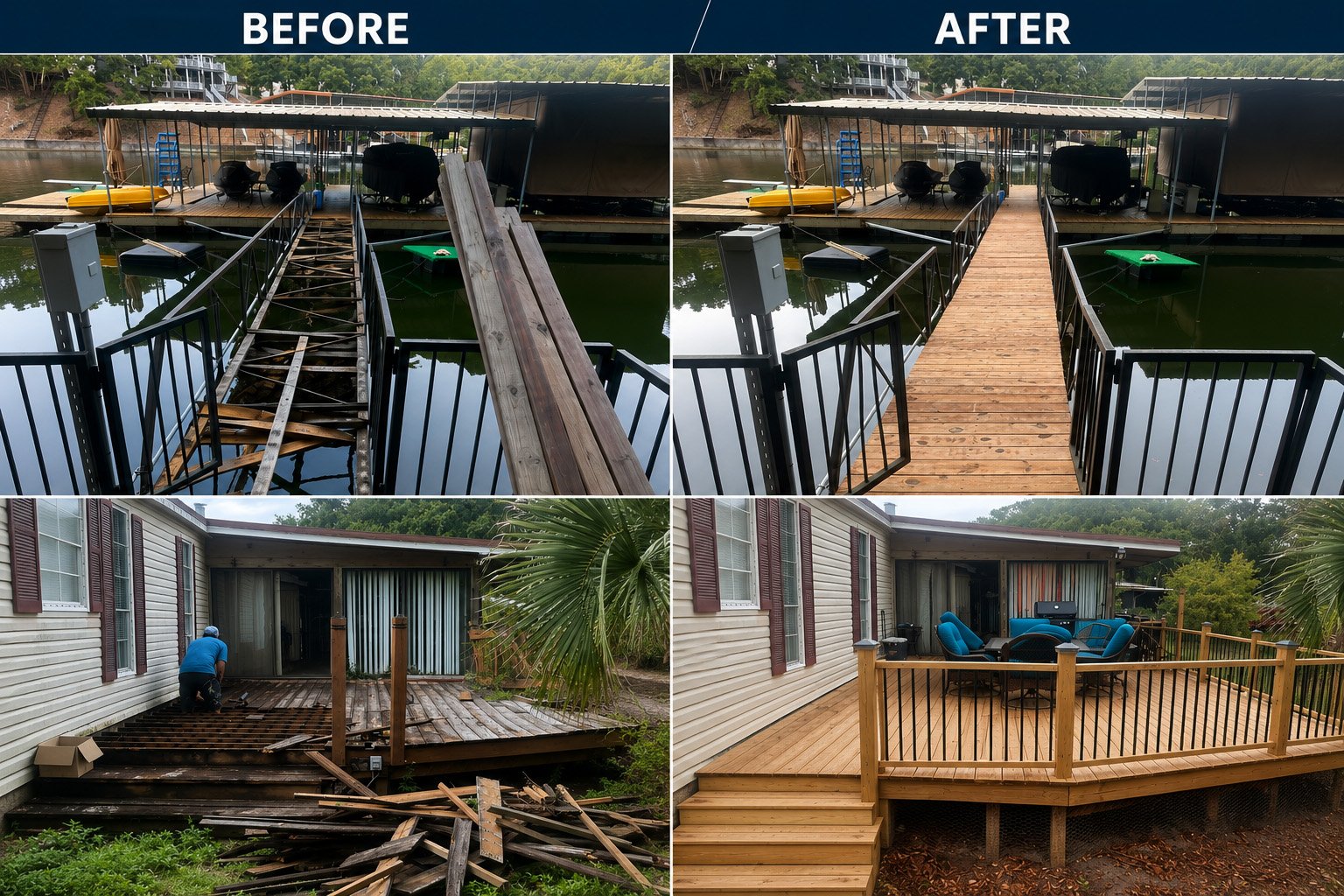
Everything the Lake Environment Puts Your Property Through — and How to Stay Ahead of It
A lakefront property at Lake of the Ozarks is an investment in an experience — in the specific feeling of being on the water, in the sunrises over the cove, in the summers that families and guests return to year after year. Protecting that investment isn’t just about maintaining property value, though that matters. It’s about keeping the experience intact — making sure the dock is safe and clean for every arrival, the deck is inviting rather than weathered and neglected, the walkways are clear and bright rather than slick and stained, the home looks the way it should for the place and the investment it represents.
Every exterior surface on a Lake of the Ozarks property is being worked on continuously by an environment that’s more demanding than most homeowners have experienced at a primary residence. The humidity off the water never fully lets go through the warm months. Algae establishes on every horizontal surface that stays wet. Mold advances on every surface that stays shaded. UV exposure weathers and opens unprotected wood. Missouri’s freeze-thaw cycling stresses every moisture-carrying pore in wood and concrete through winter. And the biological growth, the moisture damage, and the structural deterioration that these conditions produce compound with every season they’re not actively managed.
This guide covers every exterior surface category on a Lake of the Ozarks lakefront property — what each surface faces, what maintenance it specifically requires, when that maintenance should happen, and what happens when it’s deferred. It’s the comprehensive reference that ties together everything a lake property owner needs to know about staying ahead of the environment rather than catching up to it.
My Handyman LOZ has been providing every exterior maintenance service a Lake of the Ozarks property requires — from Lake Ozark to Osage Beach, Camdenton to Sunrise Beach, Laurie to Four Seasons, Porto Cima to Linn Creek and Eldon — since 1992. This guide is built on three decades of observing what consistent maintenance produces and what deferred maintenance costs.
**📞 Call (573) 217-6060 | Text Photos for a Fast Estimate**
Surface 1: The Dock — Your Highest-Maintenance Exterior Asset
The dock is the exterior surface at a Lake of the Ozarks property that faces the most aggressive combination of maintenance pressures — direct water contact, constant biological growth conditions, UV exposure, heavy foot traffic, and structural stresses from wave action, boat loading, and seasonal freeze-thaw cycling. It’s also the surface where maintenance failures have the most immediate safety consequences.
What the Dock Faces
**Biological growth** — algae, mold, and the biofilm layer beneath both — establishes on dock surfaces continuously through the warm season. Algae creates the slip hazard. Mold advances into wood fiber and drives the structural deterioration that produces soft boards. Biofilm is the invisible foundation that both rebuild from after surface cleaning, which is why cleaning methods that don’t treat biofilm produce results that degrade faster than homeowners expect.
**UV exposure** on sun-facing dock surfaces weathers and opens wood grain — a degradation process that makes wood more moisture-absorbent, more hospitable to biological growth, and more vulnerable to the freeze-thaw cycling that winter delivers.
**Structural stresses** from wave loading on open-water positions, boat tie-up loading on cleats and dock edge connections, and the wet-dry cycling that keeps dock fastener hardware in continuous corrosion conditions advance the mechanical wear that biological and moisture damage doesn’t produce on its own.
The Dock Maintenance Calendar
**Spring opening — April:**
- Professional soft washing of the full dock surface with biofilm treatment — dock boards, railings, steps, and ramp
- Dock roof cleaning — removes the mold and algae that’s been established since last fall and that seeds the dock surface below with every rain event
- Systematic structural assessment after cleaning — board-by-board pressing, railing post lateral pressure testing, stair and ramp loading assessment, below-surface structural inspection
- Repair of any structural concerns identified before first use of the season
- Protective staining if surfaces are prepared and drying window allows
**Midsummer — June to July:**
- Dock surface soft wash refresh for high-traffic properties, vacation rental docks, or any dock in a position where biological growth advances faster than twice-yearly cleaning controls
- Spot assessment of any structural items that were borderline at spring opening
**Fall closing — September to October:**
- Complete dock soft washing to remove the season’s biological accumulation before winter close
- Structural walk-through to identify any items that advanced through the season
- Dock staining if surfaces and conditions allow before temperatures drop below application minimums
- Documentation of condition at closing for comparison at spring opening
Key Maintenance Rules for Docks
- **Clean before assessing.** Biological growth conceals board condition. Assessment before cleaning produces inaccurate scoping — boards that appear to need replacement may not, and boards that appear stained but treatable may have hidden soft spots.
- **Roof before surface.** Dock roof cleaning always precedes dock surface cleaning so roof runoff doesn’t re-contaminate a freshly cleaned surface.
- **Repair before staining.** Staining over compromised boards conceals structural problems rather than addressing them.
- **Biofilm treatment matters.** Surface cleaning without biofilm treatment produces results that degrade faster — because the growth foundation wasn’t treated, only the visible surface.
Surface 2: The Deck — Outdoor Living Space and Structural Asset
The deck connects the home to the lake experience — it’s visible from inside through back-facing windows, central to the listing photography for vacation rental properties, and the gathering space that makes a lake property feel like a lake property. Its maintenance requirements are similar to the dock’s but differ in specific emphasis.
What the Deck Faces
The deck faces the same biological growth, UV degradation, and freeze-thaw cycling that the dock faces — with some position-specific differences. Many Lake of the Ozarks decks have sections under tree canopy that face more aggressive mold and less UV than open-water dock surfaces. Some face the full afternoon sun on west-facing elevations. Many have the split-condition challenge where one end faces one failure mode and the other faces a different one.
**Structural deterioration on decks** concentrates at the same locations as on docks — board gaps where organic debris accumulation feeds rot from the sides, shaded sections that stay damp longest, post bases where sustained moisture contact advances rot at the connection point, and under furniture positions where persistent shading creates localized biological growth zones.
The Deck Maintenance Calendar
**Spring opening:**
- Professional deck cleaning — removes biological growth, organic debris, and surface contamination
- Structural assessment — board-by-board pressing, railing testing, stair assessment
- Repairs before staining
- Staining after adequate drying (48-72 hours for cleaned wood, 30-90 days for new lumber)
**Fall closing:**
- Complete deck cleaning to remove season’s biological load before winter
- Staining if scheduled and conditions allow
- Structural check before closing
**Between service visits:**
- Clear organic debris from board gaps and deck surface — removes the nutrient source that feeds biological growth
- Move furniture periodically to prevent persistent shaded wet zones
- Note any new soft spots or structural changes for professional assessment
Surface 3: The Dock Roof — Overlooked But Critical
Dock roof maintenance is the category most consistently deferred at Lake of the Ozarks — and the deferral that produces consequences at two levels simultaneously: the roof material itself and the dock surface below.
What the Dock Roof Faces
Dock roof surfaces accumulate biological growth from above (organic debris from tree canopy, rain-carried biological material) and from below (humidity rising from the warm lake water beneath). The underside surfaces in particular — in continuous contact with humid lake air — can carry more extensive biological growth than the top surface.
Every rain event and dew cycle on a mold-covered dock roof carries biological material down onto the dock boards below. A dirty dock roof is an active inoculation source for the dock surface — which is why dock surfaces beneath uncleaned roofs regrow biological material faster than dock surfaces beneath clean roofs, even when both dock surfaces are cleaned at the same frequency.
The Dock Roof Maintenance Standard
**Twice yearly minimum** — spring and fall — with midsummer refresh for heavily shaded positions or vacation rental properties where presentation matters through the full season.
**Always clean roof before dock surface** — so roof runoff doesn’t contaminate the dock surface during the cleaning process.
**Soft washing, not pressure washing** — high pressure on metal roof panels forces water under seams and panel overlaps, creating moisture infiltration damage that soft washing avoids.
**Include underside surfaces** — soffit surfaces, fascia, and the underside of roof panels where biological growth from cove humidity is often more advanced than the top surface.
Surface 4: Concrete — Driveways, Walkways, and Approach Areas
Concrete at Lake of the Ozarks faces a combination of biological growth pressure, moisture infiltration, and freeze-thaw cycling that makes it deteriorate faster than comparable concrete at inland properties — and that makes sealed, maintained concrete perform significantly better over time than unsealed, neglected concrete.
What Concrete Faces
**Biological growth** — algae on concrete creates slip hazards that are as dangerous as algae on dock boards, but on surfaces where guests arrive with luggage and limited traction footwear. Algae also produces organic acids that chemically attack cement paste and accelerate surface pitting.
**Moisture infiltration** through the pore structure — the lake’s persistent humidity keeps concrete at elevated moisture content, and that moisture is what freeze-thaw cycling works on through Missouri winters. Nine percent expansion when water freezes, multiplied over fifteen to twenty freeze-thaw cycles per winter, produces progressive micro-fracturing that leads to surface spalling and crack development.
**Joint and crack infiltration** — failed caulking in expansion joints allows direct water infiltration to the concrete substrate and base material, bypassing the surface protection that sealing provides.
The Concrete Maintenance Calendar
**Spring:**
- Professional pressure washing of all concrete surfaces — driveways, walkways, dock approaches, retaining walls
- Assessment of joint caulking condition — deteriorated joints need caulking before or concurrent with sealing
- Concrete sealing if the previous sealing application has been exhausted (water no longer beads, sealing worn)
**Fall:**
- Concrete cleaning before freeze-thaw season
- Caulking of any joint failures identified during cleaning
- Sealing if scheduled or if the previous application has worn
**Annual:**
- Professional cleaning is the annual standard regardless of sealing cycle
- Sealing every two to four years depending on traffic, sun exposure, and specific product applied
Surface 5: The Home Exterior — Siding, Trim, and Paint
The home exterior at a Lake of the Ozarks property faces the same biological growth, UV, and moisture pressures as the dock and deck — on surfaces that are larger, more complex, and where failure has both visual and structural building-envelope consequences.
What the Home Exterior Faces
**Mold and algae** concentrate on the shaded surfaces — north and west-facing walls, undersides of eaves, areas behind downspouts and behind landscaping that limits airflow. On painted wood surfaces, mold that establishes beneath the paint film causes blistering and peeling from below — the most expensive exterior paint failure mode, and the one most directly prevented by annual professional washing.
**UV degradation** on south and west-facing surfaces fades color, degrades binder chemistry, and produces the chalking that precedes paint surface failure on sun-exposed elevations.
**Moisture infiltration** through failed caulking at joints, through degraded paint films, and through the lake’s humidity-driven moisture input to wood substrates drives the blistering and adhesion failures that shorten paint life.
The Home Exterior Maintenance Calendar
**Annual professional soft washing** — spring before the season opens or fall before close. Annual washing removes biological growth before it establishes beneath paint films, removes UV oxidation before it compromises paint surface integrity, and removes the organic staining that accumulates on lake property home exteriors through the season.
**Caulking inspection and repair** — at every window and door surround, at siding-to-trim junctions, and at any penetration through the exterior wall assembly. Failed caulking is the primary moisture infiltration pathway that drives paint blistering and early failure.
**Exterior painting** — when paint failure has advanced to blistering, extensive peeling, or significant fading, full surface preparation and repainting is warranted. With consistent annual washing, paint life at Lake of the Ozarks should extend to five to eight years. Without consistent maintenance, paint may fail in two to four years, requiring early repainting.
The Integrated Maintenance Program — How All the Services Work Together
The exterior maintenance services described above aren’t independent — they’re part of an integrated property care program where each service supports the others and where the whole is more effective than the sum of the parts.
**Dock roof cleaning supports dock surface maintenance.** A clean roof stops inoculating the dock surface below — making dock surface cleaning results last longer between service visits.
**Cleaning before staining makes staining last longer.** Stain on properly cleaned wood bonds to wood fiber rather than contamination. Stain on cleaned, sound wood doesn’t conceal structural problems. Stain on properly prepared wood delivers its full service life.
**Structural assessment during cleaning catches problems early.** Every cleaning service is an opportunity to identify structural concerns at the earliest detectable stage, when repair cost and scope are at their minimum.
**Concrete caulking before sealing makes sealing effective.** Sealing provides surface moisture protection. Caulking provides joint and crack moisture protection. Both together address the full concrete moisture management picture.
**Annual exterior washing extends paint life.** Preventing mold from establishing beneath paint films through annual washing is more effective and less expensive than repainting after mold-driven adhesion failure.
The property owner who approaches exterior maintenance as an integrated program — with all services coordinated in the right sequence and the right timing — gets better results from each individual service and a better overall maintenance outcome than the property owner who addresses each service in isolation.
The Two-Window Annual Calendar
For most Lake of the Ozarks property owners, the integrated exterior maintenance program runs through two primary service windows per year:
Spring Opening Window — April
Everything that winter has done to the property’s exterior surfaces gets addressed in this window. The goal is a property that opens the season in the condition its listing, its guests, and its family expect.
**Spring opening service includes:**
- Dock cleaning (roof first, surface second) with biofilm treatment
- Dock structural assessment after cleaning
- Any structural repairs identified before first use
- Deck cleaning and structural assessment
- Concrete pressure washing
- Home exterior soft washing
- Concrete caulking where needed
- Staining if surfaces are prepared and conditions allow
Fall Closing Window — September to October
Everything that the season has accumulated gets removed before winter. The goal is a property that closes with the biological load cleared, the moisture load reduced, and any structural concerns identified before the unobserved winter months.
**Fall closing service includes:**
- Complete dock cleaning (roof and surface)
- Deck cleaning
- Concrete cleaning and caulking
- Staining where scheduled and conditions allow
- Structural walk-through
- Documentation of condition at closing
**February and March** — book both service windows for the coming year. Spring availability at Lake of the Ozarks fills fast, and properties that book early get the service timing that allows complete preparation before Memorial Day.
Frequently Asked Questions — Lakefront Property Exterior Maintenance
What’s the most important exterior maintenance service for a Lake of the Ozarks property?
Dock cleaning — both because it produces the most direct safety benefit (eliminating the algae slip hazard) and because it prevents the biological growth that causes the most expensive structural deterioration on the most valuable exterior asset. If you can only do one thing, professional dock cleaning twice a year is the most impactful choice.
How much does a complete annual exterior maintenance program cost at Lake of the Ozarks?
The cost depends on property size, specific services needed, and the condition of surfaces at the time of service. My Handyman LOZ provides estimates after assessing the specific property — call (573) 217-6060 or text photos for a preliminary estimate. The consistent finding is that annual maintenance programs cost significantly less than the repair or restoration services that deferred maintenance eventually requires.
Can My Handyman LOZ handle all exterior maintenance services at my property?
Yes — power washing, soft washing, dock cleaning, dock roof cleaning, deck cleaning, deck staining, dock staining, deck repairs, dock repairs, wood replacement, concrete cleaning, concrete sealing, concrete caulking, and exterior painting are all services My Handyman LOZ provides. One contractor, full-service capability, complete exterior maintenance from a single experienced crew.
Do you work with vacation rental owners on maintenance schedules around their booking calendars?
Yes — vacation rental property maintenance scheduling around booking calendars is standard practice. We work within the service windows that the rental calendar allows, provide service documentation and completion photos for remote owners, and coordinate with property managers as needed.
What’s the single biggest exterior maintenance mistake Lake of the Ozarks homeowners make?
Deferred dock cleaning — specifically, skipping the spring opening clean and allowing the season to run on a dock that wasn’t reset from its winter condition. The biological growth that accumulates through one season without cleaning becomes the compounding foundation for faster growth in the next, and the structural deterioration that uninterrupted mold activity drives through one season advances noticeably by the next spring opening.
How do I know if my lake property needs My Handyman LOZ or if I can handle maintenance myself?
The surfaces you can effectively maintain with consumer equipment and products — light debris clearing, basic rinsing — are fine to handle yourself. The services that require professional-grade equipment, correct chemistry, structural assessment experience, and repair capability — dock and deck cleaning with biofilm treatment, concrete cleaning before sealing, exterior soft washing without pressure damage, structural inspection and repair — are the services where professional execution produces results that DIY methods don’t match. My Handyman LOZ is the right call for the services where method, chemistry, and experienced assessment matter.
Thirty-Plus Years. Every Surface. Done Right.
My Handyman LOZ has been maintaining every exterior surface at Lake of the Ozarks properties since 1992 — through every seasonal cycle, every type of property, and every stage of maintenance from clean and well-maintained to thoroughly neglected and in need of restoration. We know what these surfaces face. We know the right methods for each one. And we know that the properties whose owners maintain consistently and correctly are the ones that look the way they should season after season — safe for guests, beautiful from the water, and worth every bit of what was invested in them.
**📞 Call (573) 217-6060**
**📱 Text Photos for a Fast Estimate**
**🌐 Schedule Your Complete Exterior Maintenance Program — Contact Page**
*Serving Lake Ozark, Osage Beach, Camdenton, Sunrise Beach, Laurie, Four Seasons, Porto Cima, Linn Creek, Eldon, and the surrounding Lake of the Ozarks communities since 1992.*