
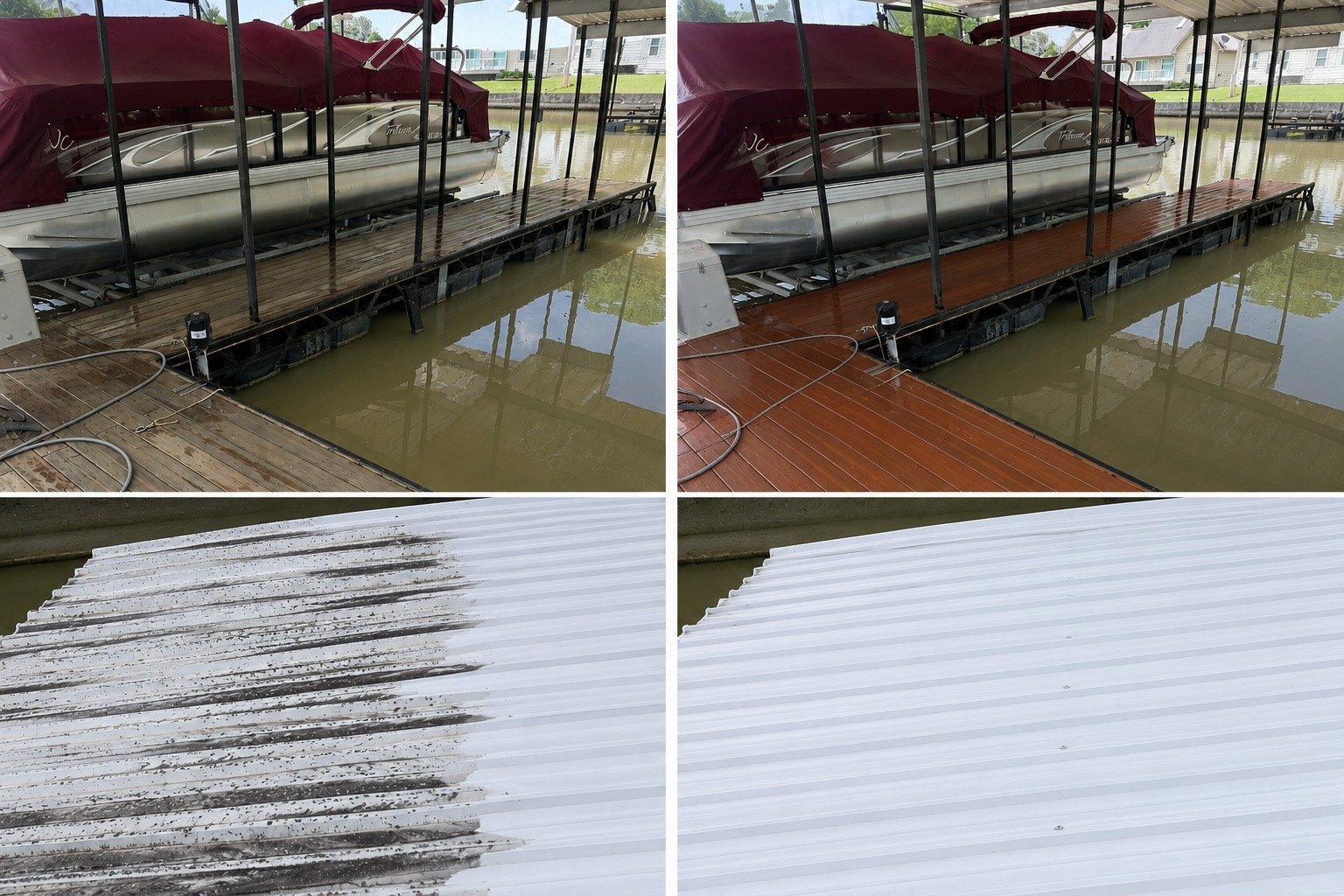
Why Deck Stain Selection Matters More at the Lake
Walk into any home improvement store and you’ll find an entire aisle of deck stain products — dozens of brands, hundreds of color options, competing claims about durability and weather resistance and ease of application. For a homeowner maintaining a deck at an inland location with moderate sun and reasonable humidity, the product selection is relatively forgiving. Most quality products applied to properly prepared wood perform adequately.
At Lake of the Ozarks, the margin for error is narrower. The combination of intense UV exposure on sun-facing surfaces, persistent lake humidity, warm biological growth conditions, and Missouri’s freeze-thaw cycling creates an environment where the wrong product choice — or the right product applied without the right preparation — produces results that fail noticeably within a season or two.
The homeowner who picks up a deck stain at the hardware store based on the color they like, skips the preparation sequence because the deck doesn’t look that dirty, and applies on a humid June afternoon isn’t going to get four or five seasons from their stain job. They’re going to get one season that looks okay and a second season that reveals peeling and uneven fading — and then a conversation about what went wrong.
Getting deck stain selection right at Lake of the Ozarks means understanding what the lake environment specifically requires from a stain product, what the application conditions that determine performance look like, and what the preparation sequence that allows a quality stain to deliver its full protective value requires. That’s what this article covers.
My Handyman LOZ has been cleaning, preparing, and staining decks and docks throughout Lake Ozark, Osage Beach, Camdenton, Sunrise Beach, Laurie, Four Seasons, Porto Cima, Linn Creek, Eldon, and the surrounding communities since 1992. Stain selection is a conversation we have with every client — and the guidance below reflects thirty-plus years of observing what works on lake decks and what doesn’t.
**📞 Call (573) 217-6060 | Text Photos for a Fast Estimate**
The Two Fundamental Stain Categories — and Which One Belongs on Lake Decks
Before getting into specific product characteristics, the most important stain selection decision for most Lake of the Ozarks deck and dock owners is the choice between the two fundamental stain categories: penetrating stains and film-forming stains. Getting this category decision right determines more about long-term performance than any other single selection variable.
Penetrating Stains (Also Called Semi-Transparent or Transparent Stains)
Penetrating stains absorb into the wood fiber rather than forming a film on the surface. The active ingredients — pigments, UV absorbers, water repellents, and mildewcide compounds — are carried into the wood by the stain’s carrier chemistry, where they occupy the pore structure and surface cells of the wood fiber.
**How penetrating stains protect:**
- UV absorbers and stabilizers within the wood fiber intercept UV radiation before it reaches and begins photodegrading the lignin beneath them
- Water repellents in the pore structure reduce moisture absorption, limiting the biological growth and freeze-thaw damage that elevated wood moisture content drives
- Mildewcide compounds in the wood fiber resist biological growth establishment at the surface and near-surface level
- The wood’s natural grain and texture remain visible, since the stain colors and protects without forming an opaque film
**How penetrating stains fail:**
Penetrating stains don’t fail the way film-forming stains do. They don’t peel, crack, or blister — they wear away gradually and uniformly as UV exposure depletes the UV absorbers and weather cycling removes stain from the outermost wood cells. The indication that a penetrating stain needs renewal is the gradual return of unprotected wood symptoms — slight gray coloring on sun-facing surfaces, slightly increased moisture absorption — rather than dramatic visible failure.
**Reapplication on penetrating stains:**
When a penetrating stain needs renewal, it typically can be reapplied directly over the existing stained surface after professional cleaning — without stripping the previous application. This is a significant maintenance advantage over film-forming stains, which require stripping any failed film before reapplication.
Film-Forming Stains (Also Called Solid Stains) and Paints
Film-forming stains and solid stains sit on the wood surface rather than penetrating into it — they create a coating over the wood that protects by sealing the surface rather than by integrating with it.
**How film-forming stains protect:**
- The continuous film barrier blocks UV, moisture, and biological growth access to the wood surface
- Solid pigment in the film provides UV opaqueness that limits UV transmission to the substrate
- The film’s physical barrier prevents surface biological growth from directly accessing wood fiber
**How film-forming stains fail — and why this is a problem at Lake of the Ozarks:**
Film-forming stains fail by cracking, peeling, and blistering — and when they fail, the failure mode is more problematic than penetrating stain wear in several ways.
Cracking and peeling in the film creates moisture traps — sections where water gets behind the film but can’t evaporate because the film covers it. The trapped moisture accelerates the wood deterioration that the film was protecting against. At Lake of the Ozarks, where ambient humidity provides continuous moisture input to any opening in a film surface, this failure mode produces rapid deterioration in the areas of film failure.
Peeling also creates a remediation challenge. Before reapplication, all peeling film must be removed — an involved process that adds significantly to the time and cost of repainting. A film that fails in two or three seasons requires stripping and full reapplication, while a penetrating stain that needs renewal at the same interval can be cleaned and recoated without stripping.
**For most Lake of the Ozarks deck and dock applications, penetrating stain is the correct choice.** Film-forming stains have their appropriate applications — on surfaces where a consistent, opaque color is specifically desired and where the maintenance commitment of film failure management is acceptable. But for the majority of lake dock and deck surfaces, penetrating stain delivers better long-term performance in the conditions that Lake of the Ozarks produces.
The Key Performance Properties to Evaluate in a Lake of the Ozarks Deck Stain
Within the penetrating stain category, there’s still significant performance variation between products — and the properties that matter most for Lake of the Ozarks conditions are specific.
UV Resistance and Stabilizer Quality
UV exposure is one of the primary failure mechanisms for deck stain at Lake of the Ozarks — particularly on south and west-facing surfaces that receive both direct solar UV and reflected UV from the lake surface below. The UV absorbers and stabilizers in a stain product determine how long the stain provides effective UV protection before depletion.
Quality deck stains formulated for exterior wood protection contain UV absorber or stabilizer compounds — typically benzotriazoles, hindered amine light stabilizers (HALS), or similar UV-intercepting chemistries. The loading level and quality of these compounds in a stain formulation is a primary determinant of how long the stain maintains effective UV protection under active UV exposure.
**What to look for:** Stain products that specifically call out UV protection as a performance characteristic, with mention of UV absorbers or stabilizers in the product description. Budget stain products often have minimal UV protection chemistry — adequate for covered or minimally exposed surfaces but insufficient for open-water Lake of the Ozarks sun exposure.
**Position-specific consideration:** Sun-exposed south and west-facing deck and dock surfaces at main channel positions in Lake Ozark, Osage Beach, and Linn Creek face the highest UV loading and benefit most from maximum UV stabilizer quality. Shaded cove positions in Camdenton, Sunrise Beach, and the Gravois arm near Laurie have lower UV pressure and may not require the same UV stabilizer loading — though mildewcide performance becomes more important in these positions.
Mildewcide Effectiveness
Mildewcide additives in deck stain are what provide biological growth resistance on lake deck surfaces between cleaning cycles. The mildewcide compounds in quality exterior stains inhibit mold and algae establishment on the stained surface, slowing the biological growth cycle that’s essentially continuous in Lake of the Ozarks conditions.
**What to look for:** Stain products that specifically include mildewcide as a formulated component, not as an additive that the user mixes in. Formulated mildewcide products have the right distribution of active compounds throughout the stain; additive mildewcides mixed into stain at application can have variable distribution and effectiveness.
**The mildewcide limitation:** Mildewcide in deck stain slows biological growth establishment — it doesn’t eliminate it permanently. At Lake of the Ozarks, the biological growth pressure is persistent enough that even quality mildewcide-containing stain will eventually develop some surface growth. The mildewcide extends the clean appearance window and reduces cleaning frequency; it doesn’t replace the need for professional cleaning between staining cycles.
**Shaded position priority:** On shaded cove positions throughout Camdenton, Sunrise Beach, and the Gravois arm where biological growth pressure is most intense, mildewcide quality in the stain product is the highest-priority performance characteristic — more important than UV resistance in positions that receive limited direct sun.
Water Repellency and Moisture Management
The water repellency that deck stain provides — through the water repellent compounds it carries into the wood’s pore structure — is what limits the moisture absorption that drives biological growth, freeze-thaw damage, and structural wood deterioration.
**What to look for:** Stain products with water repellent compounds in the formulation, typically waxes, silicones, or similar hydrophobic chemistries. The water repellency of a quality penetrating stain is observable immediately after application as water beading on the stained surface — an indication that the hydrophobic compounds have been deposited in the wood pore structure.
**The drying time connection:** Water repellency performance from deck stain is only achieved when the stain is applied to adequately dry wood. Stain applied to wood with elevated moisture content — new pressure-treated lumber that hasn’t dried adequately, or deck boards that were cleaned but not allowed sufficient drying time — can’t fully penetrate into moisture-saturated pores. The water repellent compounds are deposited on the surface rather than carried deep into the pore structure, producing surface-level protection rather than the deeper moisture management that properly dried wood accepts.
How Wood Species and Condition Affect Stain Selection and Application
The wood the stain is going onto — its species, treatment type, age, and current condition — affects both which stain performs best and how the application needs to be approached.
New Pressure-Treated Lumber
New pressure-treated lumber contains elevated moisture from the treatment process — the preservative chemicals that protect it against moisture and biological damage are water-carried into the wood during manufacturing. This treatment moisture needs to be allowed to dry before stain application.
**The 30 to 90 day rule:** New pressure-treated lumber typically needs 30 to 90 days of drying after installation before stain is applied for adequate penetration and adhesion. The specific drying window depends on the product’s original moisture content, environmental conditions, and the stain product’s penetration requirements.
**Testing for readiness:** A simple water droplet test indicates readiness for staining — drop water onto the lumber surface. If it beads and sits on the surface, the lumber is still too wet to stain effectively and the water repellents and other active compounds in the stain can’t penetrate properly. If the water soaks in within 30 seconds or so, the moisture content is low enough for stain penetration.
**Stain product selection for new lumber:** New pressure-treated pine accepts semi-transparent penetrating stains well once properly dried. The relatively open grain structure of new lumber provides good absorption of stain chemistry when the moisture content is appropriate.
Weathered and UV-Damaged Wood
Older, UV-weathered dock and deck boards have surface characteristics that affect stain application — the raised grain from UV degradation creates a rougher surface that absorbs stain unevenly, and the permanent gray color from lignin photodegradation may show through semi-transparent stain products.
**Pre-staining preparation for weathered wood:** Professional cleaning followed by light sanding smooths raised grain and creates a more uniform surface that accepts stain more evenly. Without this surface preparation, stain applied to heavily weathered wood may absorb inconsistently — darker in the areas of most weathering and lighter in less-affected areas, producing a blotchy appearance.
**Stain opacity consideration for weathered wood:** On heavily weathered boards where gray discoloration is significant, a semi-transparent stain may not provide enough pigment to cover the discoloration adequately. A semi-solid penetrating stain — more pigment than semi-transparent, but still penetrating rather than film-forming — provides better color coverage on weathered wood while maintaining the penetrating stain’s maintenance advantages over film-forming products.
Cedar and Hardwood Decking
Cedar and premium hardwood decking (ipe, mahogany, and similar species) have specific stain compatibility considerations that differ from pressure-treated pine.
**Cedar:** Cedar’s natural oils can interfere with some stain chemistries — specifically, some oil-based penetrating stains are actually quite compatible with cedar, while some water-based penetrating stains may have adhesion challenges on fresh cedar. The specific stain-to-cedar compatibility should be verified before application. Cedar typically accepts penetrating stains well once the natural surface oils have weathered slightly — new cedar that’s too fresh may repel some penetrating formulations.
**Dense hardwoods (ipe, mahogany):** Dense tropical hardwoods have tight grain structures that limit penetrating stain absorption. Specific hardwood deck oils and finishes formulated for dense exotic species provide better penetration and protection than standard pressure-treated deck stains on these materials. Applying a standard deck stain to ipe or mahogany typically produces surface-level coverage rather than the deeper penetration that provides durable protection.
The Application Conditions That Determine Performance
Even the right stain on properly prepared wood can underperform if the application conditions aren’t right. The environmental conditions at the time of application affect both how the stain penetrates and how it cures — and both penetration and curing are necessary for the stain to deliver its protective value.
Temperature Requirements
Most quality penetrating deck stains have minimum application temperature requirements — typically 50°F or above for both the ambient temperature and the surface temperature of the wood. Stain applied in temperatures below the minimum cures more slowly and may not fully polymerize, producing a softer, less durable finish than the same product applied in appropriate conditions.
At Lake of the Ozarks, the ideal staining windows are mid-spring through early fall — after the last reliable below-50°F nights of spring and before the first reliable below-50°F nights of fall. The specific timing depends on the year’s weather pattern, which is why spring staining should be scheduled with the weather in mind rather than on a fixed calendar date.
Humidity and Moisture Conditions
Stain application on a high-humidity day — or the day after rain when humidity is elevated even if the surface appears dry — can affect how stain cures and how much moisture it traps against the wood surface during curing.
**Wood surface moisture is the more important variable.** A stain applied on a humid day to adequately dry wood (as confirmed by the water droplet test) typically performs better than stain applied on a dry day to inadequately dried wood. The wood’s moisture content is the controlling variable, not the ambient humidity — though both matter.
**Timing relative to cleaning:** After professional cleaning, deck and dock wood needs adequate drying time before staining — typically 48 to 72 hours in good conditions, longer if the wood was heavily saturated or if weather conditions are humid. Staining too soon after cleaning applies stain to wood that still has elevated surface moisture from the cleaning process, compromising penetration and adhesion.
Direct Sun vs. Shaded Application
Most penetrating stain manufacturers recommend applying in the shade or in the absence of direct afternoon sun — not because sunlight damages the stain chemistry directly, but because direct sun heats the wood surface and accelerates drying of the stain carrier before the active compounds can fully penetrate.
Stain applied to a hot, sun-heated dock surface in direct afternoon sun may dry at the surface before it’s fully penetrated into the wood pore structure — producing surface adhesion rather than the deeper penetration that makes the stain durable. Scheduling staining for morning hours or for overcast conditions helps ensure the stain has adequate time to penetrate before the carrier evaporates.
The Complete Staining Sequence for Lake of the Ozarks Decks and Docks
Getting the stain selection right is necessary but not sufficient — the preparation sequence that precedes stain application is what determines whether the right product delivers its full protective value or performs below expectations despite being appropriately chosen.
**Step 1 — Professional cleaning.** Remove all biological growth, surface staining, oxidation, and contamination from the deck or dock surface. Stain cannot penetrate or bond properly to contaminated wood — it bonds to the contamination layer, not the wood.
**Step 2 — Assessment.** After cleaning, assess actual board condition. Any boards that are structurally compromised — soft underfoot — need replacement before staining. Staining over structurally failed boards is cosmetic concealment of a structural problem.
**Step 3 — Board replacement.** Replace boards identified in assessment using appropriate material for the application. New lumber needs adequate drying time before staining.
**Step 4 — Surface preparation.** Light sanding of heavily weathered boards to smooth raised grain. Address any fastener heads that have backed up or are rusted through.
**Step 5 — Drying confirmation.** Confirm adequate wood moisture content using the water droplet test before staining. New lumber needs 30 to 90 days; cleaned existing lumber needs 48 to 72 hours minimum.
**Step 6 — Stain application.** Apply appropriate product using appropriate method for the specific stain formulation — brush, roller, or pump sprayer with back-brushing as the product requires. Two coats on bare or highly weathered wood where indicated by the product.
**Step 7 — Allow cure time.** Most penetrating stains need 24 to 48 hours of dry weather after application for initial curing. Heavy traffic should be avoided for the full cure period specified by the product.
My Handyman LOZ handles every step in this sequence as a coordinated project — which is the only way to ensure each step is completed correctly before the next one begins.
Frequently Asked Questions — Deck Stain Selection at Lake of the Ozarks
What’s the difference between semi-transparent and semi-solid deck stain, and which is right for lake decks?
Semi-transparent stain has lower pigment loading — it allows more of the wood’s natural grain and color to show through. Semi-solid has more pigment and provides better color coverage on weathered or discolored wood while still being a penetrating rather than film-forming product. For newer or moderately weathered dock and deck lumber, semi-transparent delivers the natural wood appearance that most lake homeowners prefer. For heavily weathered boards with significant gray discoloration, semi-solid provides better coverage of that underlying color.
How long should a quality deck stain last on a Lake of the Ozarks dock?
On sun-exposed surfaces with direct UV exposure, quality penetrating stain with UV inhibitors typically lasts two to three seasons at Lake of the Ozarks before renewal is warranted. On shaded or less UV-exposed surfaces, three to four seasons is achievable with consistent cleaning between applications. Annual professional cleaning maintains the stained surface and helps each reapplication cycle deliver its full service life.
Can I apply deck stain over an existing stain that hasn’t fully failed?
With penetrating stains, yes — if the existing stain hasn’t failed and the surface is properly cleaned, new penetrating stain can typically be applied over the old without stripping. This is one of the maintenance advantages of penetrating stain over film-forming products. However, if the existing stain is a different product type or if there’s any doubt about compatibility, testing in an inconspicuous area before full application is the right approach.
Is oil-based or water-based penetrating stain better for lake decks?
Both perform well when properly formulated with UV absorbers and mildewcide, and both need the same preparation and application conditions to deliver their full value. Oil-based penetrating stains have traditionally had an advantage in penetration depth on some wood species. Water-based penetrating stains have improved significantly in formulation quality and offer faster dry times and easier cleanup. My Handyman LOZ selects between them based on the specific application and conditions at each property.
Can I stain my deck myself, or should I hire a professional?
The staining itself is accessible as a DIY project if the preparation sequence is followed correctly and the right product is selected. The most common DIY staining failures at Lake of the Ozarks come from inadequate preparation — staining over contaminated wood, staining before adequate drying, or staining before structural assessment identifies boards that need replacement. If the preparation is done correctly, the application itself is manageable for a careful homeowner. If preparation shortcuts are taken, even a quality product produces disappointing results.
Does deck stain need to be a different product on a dock vs. a lakeside deck?
Not necessarily a different product category, but the specific performance priorities may differ. A dock that gets frequent direct water contact benefits most from maximum water repellency in the stain formulation. A sun-exposed dock facing west benefits most from UV stabilizer quality. A shaded dock in a cove benefits most from mildewcide effectiveness. My Handyman LOZ assesses the specific conditions at each property and selects products accordingly rather than applying the same product to every application regardless of conditions.
The Right Stain, The Right Preparation, The Right Conditions
Deck stain at Lake of the Ozarks isn’t a commodity decision — it’s a product and process selection that determines whether the staining investment delivers three to five seasons of real protection or one season of acceptable appearance followed by visible failure.
My Handyman LOZ brings the product knowledge and the preparation discipline to every deck and dock staining project — selecting the right stain for the specific surface, conditions, and wood type, and applying it in the correct sequence that makes the product perform the way it was designed to.
**📞 Call (573) 217-6060**
**📱 Text Photos for a Fast Estimate**
**🌐 Schedule Your Deck or Dock Staining — Contact Page**
*Serving Lake Ozark, Osage Beach, Camdenton, Sunrise Beach, Laurie, Four Seasons, Porto Cima, Linn Creek, Eldon, and the surrounding Lake of the Ozarks communities since 1992.*