
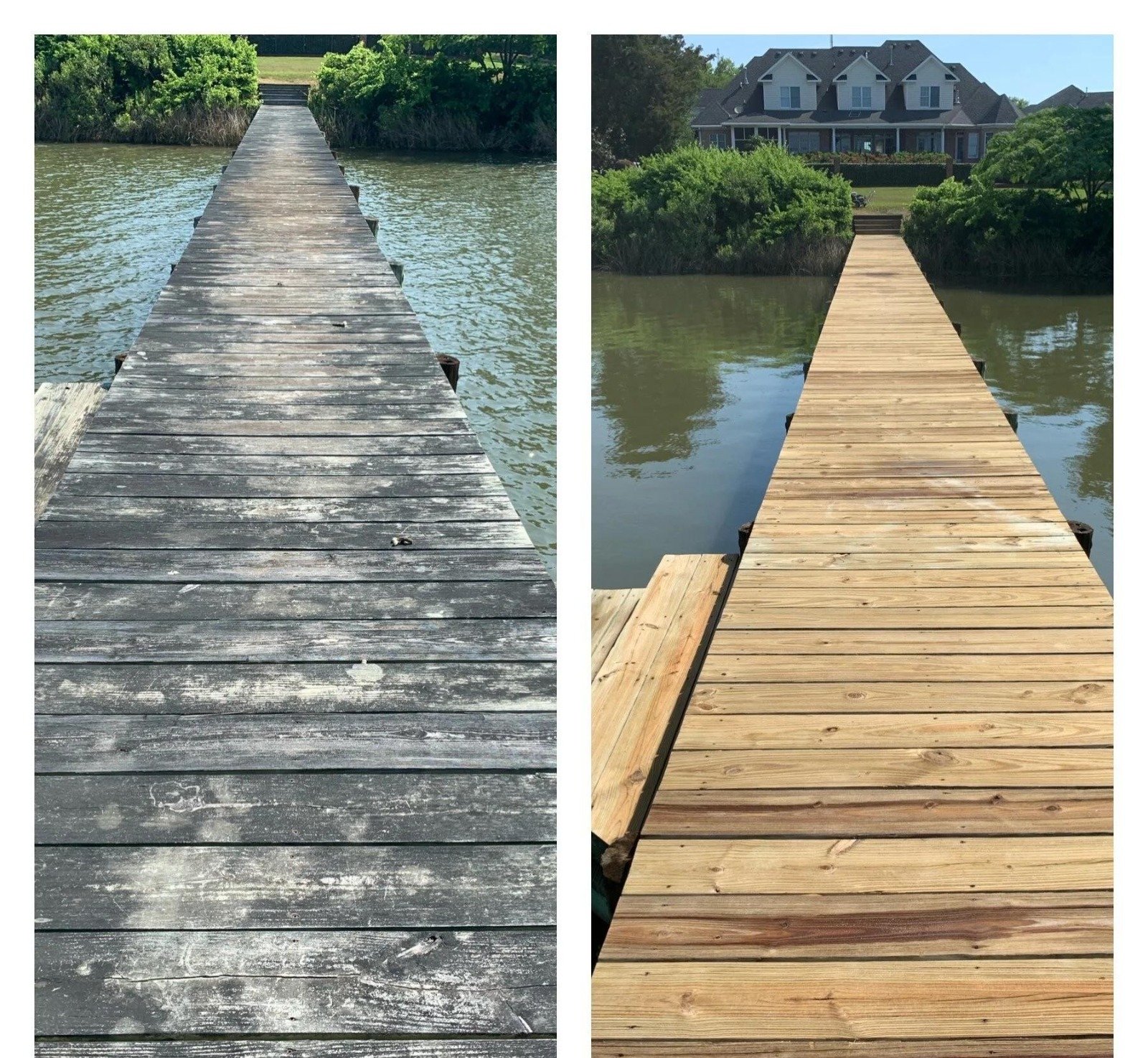
Why Dock Safety Is Every Lake Homeowner’s Responsibility
Every summer at Lake of the Ozarks, dock injuries send guests and family members to emergency rooms across the region. Some are minor — a bruised knee, a scraped palm from a catch-break fall. Others are serious — broken bones, head injuries, the kind of outcomes that end a summer and sometimes require surgical intervention.
What most of these incidents share is a dock surface or structural condition that made the fall possible — and a property owner who either didn’t know about the hazard or had been meaning to address it.
Dock safety at Lake of the Ozarks isn’t a separate subject from dock maintenance. It’s the same subject. The algae that makes dock boards slippery is a safety issue before it’s a cleaning issue. The soft board that compresses underfoot is a safety issue before it’s a replacement issue. The railing post that wobbles when pushed is a safety issue before it’s a repair issue. Every maintenance deferral on a lake dock is simultaneously a safety decision — and lake homeowners who understand that connection take dock maintenance significantly more seriously than those who think of it primarily as curb appeal.
My Handyman LOZ has been cleaning, inspecting, and repairing docks throughout Lake Ozark, Osage Beach, Camdenton, Sunrise Beach, Laurie, Four Seasons, Porto Cima, Linn Creek, Eldon, and the surrounding communities since 1992. This guide covers the complete dock safety picture — the hazards, the structural failure modes, the maintenance that addresses them, and the liability framework that makes dock safety a responsibility every lake property owner carries.
**📞 Call (573) 217-6060 | Text Photos for a Fast Estimate**
The Primary Dock Safety Hazards at Lake of the Ozarks
Hazard 1: Slippery Surfaces From Algae and Biological Growth
This is the most common cause of dock injuries at Lake of the Ozarks, and it’s the most consistently underestimated hazard because it develops gradually and looks like a maintenance issue rather than a safety crisis.
Wet algae on dock boards reduces surface friction to levels that safety researchers consistently compare to wet ice — near-zero effective traction on a surface where people arrive in bare feet, flip-flops, and wet swimsuits. The scenarios where guests and family members are moving quickly on dock surfaces — children running to jump off the dock, adults stepping off a boat onto the dock, someone carrying a cooler or fishing gear — are exactly the scenarios where a fraction-of-a-second contact with an algae-slicked surface produces a fall before there’s any time to react.
**The specific locations where algae slip hazards concentrate on lake docks:**
- The middle sections of dock boards near the waterline where splash keeps surfaces continuously wet
- Dock ramps and inclined sections where the combination of incline and biological film creates extreme slip risk
- Dock steps where treads stay damp in the shade of the step above
- The areas around dock posts and boat lift hardware where water pools after wave events
- The sections of dock beneath the dock roof overhang where limited sun creates persistent biological growth
**What the hazard looks like in practice:**
A dock surface in peak algae condition has a greenish, slightly slick appearance even when visually dry. The slip happens before the guest who’s walking on it realizes the surface is hazardous — the friction is gone before they’ve had time to adjust their gait. Guests wearing flip-flops experience complete footwear slippage in a fraction of a second on wet algae-covered boards. Bare feet on algae have slightly more contact but are still dramatically reduced from the traction that a clean dock surface provides.
**The maintenance solution:**
Professional soft washing with biofilm treatment twice yearly — spring and fall as a minimum — keeps dock surfaces free of the biological growth that creates the slip hazard. Biofilm treatment addresses the reestablishment foundation that allows rapid regrowth after surface-only cleaning. Anti-slip surface treatments applied after staining add an additional friction layer on surfaces where biological growth risk is continuous.
Hazard 2: Structural Failures — Soft Boards and Failed Sections
A dock board that compresses underfoot or fractures under load is a structural failure — and the injury that results from a foot breaking through a dock board, or from a board section giving way under a guest’s weight, is among the most serious dock injury categories.
Structural failures on dock surfaces typically aren’t dramatic collapses. They’re localized — a board section that has deteriorated past its load capacity at one point while surrounding boards remain sound. The guest who steps onto the failed section isn’t walking onto a visibly damaged surface — they’re stepping onto a dock that has looked fine for the entire visit, onto a board that gives way without warning.
**What makes structural failures difficult to detect without professional assessment:**
Biological growth covers soft boards, making them visually indistinguishable from sound boards at a casual glance. Boards that feel different underfoot — the subtle spongy response to step pressure that precedes failure — require deliberate board-by-board pressing to detect. Most guests and homeowners walking across a dock for normal use don’t apply enough deliberate foot pressure to identify the early-stage softness that precedes structural failure.
**The maintenance practice that finds structural failures before guests do:**
Professional cleaning followed by systematic board-by-board pressing — applying deliberate foot pressure to every board on the dock surface — is the assessment methodology that identifies soft boards before guests find them the hard way. My Handyman LOZ performs this systematic assessment as part of every dock cleaning service, specifically because cleaned surfaces reveal board condition that biological cover was concealing.
Hazard 3: Railing and Post Failures
A railing that fails under load when someone reaches for it is the dock safety failure mode with the highest severity injury profile — because the scenarios in which guests reach for a railing are the scenarios in which their balance is already compromised, and a railing failure in those moments produces the most serious falls.
**The specific railing failure pattern at Lake of the Ozarks:**
The most dangerous railing failure mode is the post that appears solid at shoulder height but has significant rot at the base connection — where the post meets the dock frame surface. Post bases accumulate organic debris and moisture from the deck surface above and from the lake humidity below, creating ideal rot conditions specifically at the point where the post’s structural connection to the dock frame is made. A post that’s been through two or three lake seasons with biological growth around its base connection may be compromised there while appearing and feeling solid everywhere a guest would instinctively check it.
The load that exceeds the remaining structural capacity of a rotted post base isn’t extreme — it’s the load of a guest pressing outward against the railing as they steady themselves stepping onto the dock from a boat. That’s a normal load on a sound railing. It’s a failure event on a post with a significantly compromised base connection.
**The assessment that identifies this failure mode:**
Deliberate lateral pressure testing of every railing post — applying outward and inward force at railing height while observing the base connection — is the only reliable way to identify this failure mode. Visual inspection from a standing position doesn’t detect it. Walking past the railing doesn’t detect it. Only the specific combination of lateral pressure application and attention to base movement identifies it before it fails under guest load.
Hazard 4: Stair and Ramp Failures
Dock stairs and ramps are the transition surfaces where the most severe mechanical injury outcomes from dock falls occur — because stairs involve both vertical drop and angular impact, and because the inclined surface of a ramp combined with a slippery biological film creates a severe slip scenario.
**The stair failure that’s most dangerous:**
Stringer failures at the base — where the stringer contacts or approaches grade or dock frame in persistently damp conditions — produce the sudden, complete collapse type of stair failure that gives no warning before it happens. A stringer that has been deteriorating at the base for multiple seasons produces a top surface that feels stable under normal load until the accumulated deterioration passes a threshold and the stringer fails completely. The fall that results is onto the dock surface or dock edge at the base of the stairs.
**The ramp hazard that’s most immediate:**
An algae-covered dock ramp is one of the most concentrated slip hazard points on a lake dock — the combination of incline and biological film creates an effective friction coefficient that makes normal foot traffic hazardous. Guests using a dock ramp in wet feet or flip-flops on an algae-covered surface have essentially no effective traction going downhill. Professional cleaning of ramp surfaces is part of every complete dock cleaning service at My Handyman LOZ.
Hazard 5: Dock Edge and Water Proximity
Dock edges — particularly the outer edges and the sides — are hard surfaces at water level, and falls that drive a person into a dock edge rather than cleanly into the water produce impact injuries that clean-water falls don’t. The combination of slip hazards (algae on dock surfaces) and dock edge proximity creates injury scenarios that go beyond the slip and fall — the secondary impact with the dock edge is where the serious injuries often occur.
**What this means for dock maintenance:**
Any condition that increases fall probability on a dock surface — algae, structural softness, railing failures, stair instability — simultaneously increases the risk of a dock-edge injury outcome. The safety case for addressing every slip and structural hazard is compounded by the dock edge context of the slip.
The Liability Framework — What Property Owners Are Responsible For
Lake of the Ozarks dock safety isn’t only a moral responsibility — it’s a legal one. Property owners have a duty of care to guests, visitors, and in many jurisdictions to trespassers, requiring that they take reasonable steps to maintain their property in a safe condition and warn of known hazards.
What “Reasonable Care” Means for a Lake Dock
The reasonable care standard for a Lake of the Ozarks dock owner includes:
**Regular inspection** — a dock that hasn’t been systematically inspected since it was installed isn’t a dock whose condition is known. Reasonable care requires active observation and assessment of the dock’s condition, not passive assumption that it’s fine because nothing has failed yet.
**Prompt repair of known hazards** — a property owner who identified a soft board, noted it as something to address, and deferred that repair through a subsequent season of guest use has knowledge of a hazard that they failed to remediate. That’s a difficult position to defend in any post-injury context.
**Professional maintenance documentation** — evidence of consistent professional cleaning, structural inspection, and timely repair creates a maintenance record that demonstrates the property owner exercised reasonable care. The absence of any such documentation creates the opposite implication.
**Warning of hazards that can’t be immediately remediated** — if a hazardous condition exists and can’t be immediately repaired before guest use, reasonable care requires warning guests of the specific hazard. This is a poor substitute for repair, but it’s relevant to the duty of care analysis.
The Vacation Rental Amplification
For vacation rental owners at Lake Ozark, Osage Beach, and Four Seasons, the duty of care is amplified by the commercial nature of the guest relationship. Guests who are paying for the property are paying for a safe experience — and the implied warranty of habitable condition in a rental relationship extends to the safety of outdoor structures that are marketed as amenities.
A vacation rental listing that shows dock access and dock photos is marketing the dock as part of what guests are paying for. Guests who sustain injuries on that dock have a stronger legal footing in alleging the property owner had a duty to maintain it safely than a purely social guest might. The commercial transaction elevates both the expectation and the responsibility.
The Complete Annual Dock Safety Maintenance Protocol
My Handyman LOZ recommends the following annual dock safety maintenance protocol for Lake of the Ozarks property owners:
Spring Opening Safety Assessment (Before First Guest or Family Use)
**Surface assessment after professional cleaning:**
- Walk every dock board with deliberate foot pressure, pressing each board firmly
- Note any board with compression, softness, or spongy response — these boards need replacement assessment
- Assess surface biological growth level — any algae film indicates cleaning is needed before use
- Check dock ramp surface for biological film — ramps with any algae present are slip hazards
**Railing structural assessment:**
- Apply lateral pressure (outward and inward) to every railing post
- Note any movement beyond very slight flex in the railing material itself
- Inspect base of each post for visible softness, separation, or discoloration
- Check all railing-to-post connections for looseness
**Stair and ramp assessment:**
- Load each stair tread with full body weight, shifting front-to-back and side-to-side
- Note any movement, rocking, or instability in any tread or the stair structure
- Check stringer bases visually for any softness, separation, or moisture damage
- Test ramp side rails for structural connection integrity
**Structural member inspection:**
- From beneath the dock where accessible, observe joist and beam condition
- Look for discoloration, softness, or visible deterioration at structural members and connections
- Note any section of the dock surface with unusual flex across multiple boards
**Documentation:**
- Record any items identified for repair before first use
- Schedule professional repair for any safety-critical items before the dock is used by guests or family
Midsummer Safety Check (At Mid-Season for High-Traffic Properties)
- Walk dock boards for any new soft spots not present at spring opening
- Check all railings for any new movement since spring
- Assess ramp and stair surfaces for biological growth accumulation
- Schedule professional dock surface soft wash if biological growth has accumulated to hazardous levels
Fall Closing Safety Preparation
- Complete professional dock cleaning to remove the season’s biological accumulation before winter
- Systematic structural re-assessment to identify any items that advanced through the season
- Address any identified repairs before winter close — deferred structural concerns advance through freeze-thaw cycling
- Apply protective staining if surfaces are prepared and conditions allow
- Document condition at closing for comparison at spring opening
What My Handyman LOZ Does for Dock Safety
Every dock cleaning service My Handyman LOZ performs includes more than biological growth removal — it includes the structural assessment that connects cleaning to the safety picture.
**Professional cleaning** removes the biological cover that conceals board condition — the algae and mold that makes it impossible to accurately assess which boards are structurally sound and which have crossed the failure threshold.
**Systematic board-by-board assessment** after cleaning identifies soft boards and structural concerns that the cleaned surface reveals.
**Railing post testing** at every post, with attention specifically to base connections where the failure mode that matters is least visible to casual observation.
**Honest findings communication** — every structural concern identified during a cleaning and assessment visit is reported to the property owner with an honest assessment of its safety priority and recommended repair timeline.
**Repair services** for every structural concern identified — My Handyman LOZ handles dock board replacement, railing post replacement, stair and ramp structural repair, and structural member repair as part of the same contractor relationship that handles cleaning. The assessment and the repair are handled by the same crew with the same knowledge of the property’s specific conditions.
Frequently Asked Questions — Dock Safety at Lake of the Ozarks
01. How dangerous is algae on a dock surface compared to other slip hazards?**
Very dangerous — wet algae on dock boards produces a friction coefficient that safety researchers consistently compare to wet ice. The comparison is technically accurate: effective traction on wet algae-covered wood is near-zero for the footwear guests typically wear on lake docks (bare feet, flip-flops, wet swimsuits). Falls on algae-covered docks have the same suddenness as falls on ice — there’s no friction signal before the slip that would allow a person to adjust their gait.
02.How do I know if my dock’s railings are structurally safe?**
Apply deliberate lateral pressure to each post — push outward and inward at railing height while observing the base connection. Any movement beyond very slight flex in the railing material indicates a structural concern at the base connection. This test needs to be performed on every post, because the post that fails most unexpectedly is the one that looks and feels solid above the deck while its base connection has been compromised by moisture and rot below the deck surface.
03.What are the legal consequences if a guest is injured on my dock?**
The legal consequences depend on the specific circumstances — jurisdiction, the nature of the injury, the property owner’s knowledge of the hazard, and the documentation of maintenance practices. In general, property owners have a duty of care to guests that requires maintaining the property in reasonably safe condition. Known hazards that weren’t remediated create a more difficult legal position than hazards that weren’t discoverable through reasonable inspection. Property liability insurance provides some protection, but coverage conditions and limits vary — and no insurance outcome is as good as the injury not having occurred.
04. Is it safe to use a dock that has some algae growth on it?**
Any algae present on dock surfaces creates some slip hazard — the degree of hazard depends on the extent and wetness of the biological film. A dock with light, dry algae growth presents less immediate hazard than one with wet, heavy biological film. However, “some algae” is not a standard that provides consistent safety for guests who may not know where the hazard is concentrated, who are moving quickly, or who are wearing footwear with limited traction. Professional soft washing that removes biological growth completely is the only approach that eliminates the algae slip hazard.
05.How often does a Lake of the Ozarks dock need a professional safety inspection?**
Annual professional inspection — ideally combined with spring opening cleaning — is the right standard for most lake docks. Vacation rental docks with heavy guest traffic may benefit from a midsummer inspection as well. The inspection that catches a structural concern earliest is always the one that produces the lowest repair cost and the highest safety protection.
06. What should I do if I find a safety concern on my dock before professional repair can be scheduled?**
Keep guests and family members off the specific area of concern until repair is completed. For railing concerns, mark the area and warn guests verbally. For soft board sections, block access to the section until repair is complete. For severe structural concerns that make the full dock unsafe, prevent dock access entirely until professional repair has been completed. The goal is to eliminate exposure to the hazard, not to manage guest awareness of it.
Dock Safety Is Dock Maintenance — They’re the Same Commitment
Every cleaning service, every structural inspection, every board replacement and railing repair is a dock safety decision as much as a maintenance decision. The lake property owner who maintains their dock consistently isn’t just protecting their investment — they’re protecting every person who walks out onto it.
My Handyman LOZ has been making Lake of the Ozarks docks safer through consistent professional maintenance since 1992. We clean correctly, inspect honestly, repair what needs repairing, and document everything — because the dock that’s properly maintained is the dock that nobody gets hurt on.
**📞 Call (573) 217-6060**
**📱 Text Photos for a Fast Estimate**
**🌐 Schedule Your Dock Safety Inspection and Cleaning — Contact Page**
*Serving Lake Ozark, Osage Beach, Camdenton, Sunrise Beach, Laurie, Four Seasons, Porto Cima, Linn Creek, Eldon, and the surrounding Lake of the Ozarks communities since 1992.*