
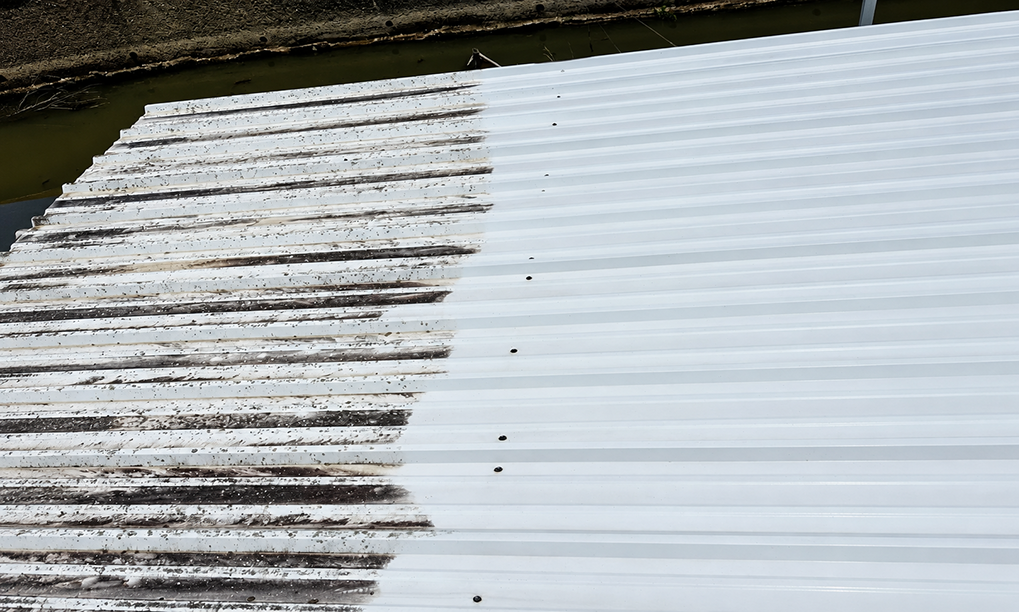
The Surface Nobody Cleans Until Guests Start Mentioning It in Reviews
There’s a consistent pattern to how dock roof cleaning becomes a priority at Lake of the Ozarks. It’s rarely a homeowner decision driven by a maintenance calendar. It’s usually one of three things: a guest reviews a vacation rental property and specifically mentions the dark, moldy dock roof. Or a neighbor mentions something to the homeowner at the marina. Or the homeowner finally really looks at the dock from the water on a clear morning and sees what’s been building on the roof for the past two or three seasons.
By that point, the dock roof that should have been cleaned last spring — and the spring before — is carrying layers of biological accumulation that don’t just look bad. They’re actively feeding the mold cycle on the dock surface below, dripping biological material onto the dock boards with every rain event, advancing the degradation of the roofing material, and communicating something about the property’s maintenance standards to every boat that passes within view.
Dock roof cleaning is the maintenance service that most consistently falls off the priority list at Lake of the Ozarks. Dock surfaces get cleaned. Deck surfaces get cleaned. The dock roof — out of reach, visible primarily from a distance, and easy to put off indefinitely — gets overlooked until it’s impossible to ignore.
This article explains why it shouldn’t be overlooked, what happens when it is, and what the right seasonal cleaning approach looks like.
My Handyman LOZ has been cleaning dock roofs on lake properties throughout Lake Ozark, Osage Beach, Camdenton, Sunrise Beach, Laurie, Four Seasons, Porto Cima, Linn Creek, Eldon, and the surrounding communities since 1992.
**📞 Call (573) 217-6060 | Text Photos for a Fast Estimate**
What Accumulates on a Lake of the Ozarks Dock Roof Every Season
A dock roof at Lake of the Ozarks isn’t just exposed to rain and sun — it’s exposed to the full biological and organic load of a Missouri lake environment from April through October, with the moisture and temperature conditions that make that biological load accumulate faster than on any other surface on the property.
The Biological Growth Cycle on Dock Roofs
**Biofilm establishes first** — the invisible microbial layer that adheres to roof surfaces and serves as the foundation for every visible biological growth stage that follows. Biofilm doesn’t need ideal conditions to establish; it needs a moist surface and organic material, both of which a Lake of the Ozarks dock roof provides continuously through the warm season. Once biofilm is established, it persists on the roof surface and serves as the reestablishment base for faster biological growth after cleaning — which is why cleaning methods that don’t treat biofilm produce results that degrade faster than homeowners expect.
**Algae follows biofilm** — establishing on the biofilm layer and spreading across the roof surface as the season advances. Green algae is typically the first visible growth on dock roofs, appearing as a greenish discoloration or slight sheen that homeowners sometimes dismiss as the natural weathering of the roofing material. It isn’t natural weathering. It’s active biological colonization that will advance to more damaging stages if not addressed.
**Mold establishes in the biological community** that algae creates — appearing as darker brown, gray, or black discoloration that streaks from high points on the roof toward the eaves as the biological mat develops and water channels carry growth downward. This is the visible stage that most homeowners associate with dock roof cleaning need — the dark streaking that becomes unmistakable from the water and from the dock surface below.
**Organic debris feeds the cycle** — pollen, leaf fragments, seed material, and organic matter from surrounding trees land on dock roof surfaces and decay there, providing nutrient input that sustains the biological growth cycle through periods when other conditions might otherwise limit it. On wooded properties throughout Camdenton, Sunrise Beach, and the Gravois arm near Laurie, this organic debris load is particularly heavy and continuous.
Why Lake of the Ozarks Conditions Accelerate Dock Roof Growth
The conditions that make biological growth on dock roofs more aggressive at Lake of the Ozarks than in most other Missouri locations are the same conditions that affect dock surfaces and deck surfaces — amplified by the specific position and orientation of dock roof surfaces:
**Elevated humidity** from the lake surface below keeps dock roof surfaces in a sustained moisture environment through the entire warm season. The underside of dock roof structures — the soffit surfaces and the framing — are in near-constant contact with humid air rising from the water below, creating biological growth conditions on the underside that can be as advanced as or more advanced than the top surface.
**Thermal cycling** on metal dock roof panels — heating significantly during afternoon sun, cooling at night — creates condensation on the underside surfaces through the cycles that keep underside moisture conditions active even when top surfaces are dry.
**Cove and sheltered positions** at Lake Ozark, Camdenton, and Sunrise Beach have limited airflow that allows biological growth to advance without the surface drying that wind movement across open water provides. North-facing dock roof surfaces in sheltered cove positions can advance to significant mold coverage within a single season.
Three Reasons Dock Roof Cleaning Matters Beyond Appearance
If dock roof mold and algae were only a visual problem, it would still matter — the visual impact on a lake property’s presentation is real and significant. But dock roof biological growth produces three additional consequences that extend well beyond appearance, and understanding them makes the case for seasonal cleaning much more compelling than curb appeal alone.
Reason 1: Dock Roofs Continuously Seed the Dock Surface Below
This is the biological consequence that most dock owners haven’t considered — and that consistently produces faster dock surface algae regrowth on docks that have a dirty roof overhead than on docks without one.
Every rain event on a mold and algae-covered dock roof carries biological material from the roof surface down onto the dock boards below. The water that runs off the roof isn’t just water — it’s water carrying mold spores, algae cells, biofilm organisms, and the organic material from the roof surface that feeds biological growth on the dock boards it lands on. The dock surface is being continuously inoculated with biological growth material from above every time it rains.
The practical result: dock surfaces beneath dirty roofs regrow algae and mold faster than dock surfaces beneath clean roofs, even when the dock surfaces themselves are cleaned at the same frequency. Cleaning the dock surface without cleaning the dock roof is addressing the symptom while leaving the primary inoculation source active. My Handyman LOZ always cleans dock roof and dock surface in the same service visit — roof first, then surface — specifically because this sequence prevents the clean surface from being immediately re-seeded by the dirty roof above it.
Reason 2: Dock Roof Biological Growth Degrades Roofing Materials
Dock roof mold and algae isn’t just sitting on the roofing material — it’s engaging with it chemically and physically in ways that advance material degradation over time.
**On metal roofing** — the most common dock roof material at Lake of the Ozarks — biological growth concentrates at panel seams, at low points where moisture pools, and at fastener locations. The organic acids that mold produces in the course of its metabolic activity are mildly corrosive to metal surfaces. This acid production, combined with the moisture that biological growth holds against metal surfaces, advances corrosion at the points where biological colonization is heaviest. Dock roof metal panels that carry sustained biological growth through multiple seasons without cleaning show corrosion advancement at seam and fastener locations that properly maintained panels don’t.
**On rubber membrane and vinyl roofing** — less common but present on older and specialty dock structures — biological growth compromises the membrane surface more rapidly than UV alone. Mold produces enzymes that can degrade polymer chains in synthetic roofing membranes over time, and the moisture that biological growth holds against membrane surfaces accelerates aging.
**On wood-framed roof structures** — where the framing beneath the roofing material is wood — biological growth that penetrates into the framing advances rot in the structural wood in the same way mold advances rot in dock boards. Dock roof framing that stays damp under biological growth and limited airflow deteriorates faster than properly maintained framing.
Regular seasonal cleaning removes the biological load before it advances to the material-damaging stage and extends roofing material service life meaningfully.
Reason 3: Dock Roof Condition Affects the Entire Property’s Presentation
A dock roof covered in dark mold streaking is visible from three directions simultaneously: from the water, where every passing boat has a clear view; from the property itself, where the dock is typically in the sightline from the house and deck; and from neighboring properties, where the condition of the dock is part of the visual landscape.
In a vacation rental context at Osage Beach or Lake Ozark, a mold-stained dock roof appears in guest photos taken from the dock — and those photos are the raw material for listing page presentations, social media posts, and the visual record that accompanies reviews. A clean dock roof in those photos communicates maintained; a dark-streaked dock roof communicates something different.
For private lake homeowners, dock roof condition affects the overall visual impression of the property from the water — which is the approach angle for visitors, guests, and anyone arriving by boat. A dock that looks well-maintained from the water, including a clean roof, presents the property at its best. A dock roof dark with years of biological growth presents the property as something else.
The Correct Cleaning Method for Dock Roofs
The cleaning method applied to a dock roof matters significantly — both for the quality and longevity of the result and for the protection of the roofing material through the cleaning process.
Why Pressure Washing Is Wrong for Most Dock Roofs
High-pressure washing on metal dock roof panels forces water under panel overlaps and seams — exactly the locations where water is most damaging to the underlying structure. The same pressure that blasts biological growth off the panel surface also drives water past the seam overlap and into the framing below. On older dock roofs where seam integrity has been reduced by years of thermal cycling, this water infiltration risk is particularly acute.
High pressure on rubber membrane and vinyl dock roofing creates abrasion damage and puncture risk that shortens membrane service life. On wood-framed roof structures, high-pressure water drives moisture into framing wood at the connection points where moisture damage is most consequential.
Beyond the material damage risk, high-pressure washing doesn’t treat the biofilm layer that drives rapid biological reestablishment. The visible mold and algae are removed. The biofilm that allows them to reestablish quickly is untouched. The result looks clean immediately and returns to visible biological growth within a shorter period than the homeowner expects.
Why Soft Washing Is the Correct Method
Soft washing uses low-pressure water application combined with professional-grade cleaning solutions — algaecides, mildewcides, and biofilm-penetrating surfactants — that kill biological growth at the cellular level rather than just removing the visible surface layer.
**The chemistry reaches the biofilm layer.** Professional soft washing solutions penetrate through established biological growth to the biofilm foundation, treating the reestablishment base rather than just cleaning the surface. Results last significantly longer because the growth cycle has been interrupted at its foundation rather than just cleared at the top.
**Low pressure protects the roofing material.** No forced water infiltration through seams. No abrasion damage to membranes. No additional moisture pressure on wood framing. The cleaning process doesn’t create new problems while solving the existing one.
**The complete structure is addressed.** Soft washing effectively reaches into underside soffit surfaces, eave areas, and the vertical faces of dock roof structures that high-pressure washing would risk damaging. The complete dock roof structure — top surface, underside, soffits, fascia, and accessible framing — is addressed in a single properly executed soft wash service.
My Handyman LOZ calibrates soft washing chemistry and application for the specific roofing material present — metal panel, rubber membrane, vinyl, or wood-framed — because the right chemistry for one material isn’t necessarily the right chemistry for another.
How Often Does a Lake of the Ozarks Dock Roof Need Cleaning?
The right cleaning frequency depends on the specific conditions at each dock roof — sun exposure, shade, cove position, organic debris load from surrounding vegetation, and seasonal use patterns.
**Twice yearly — spring and fall — is the standard for most Lake of the Ozarks dock roofs.** Spring cleaning before the season opens removes the winter and early spring biological accumulation before the season’s high-growth conditions begin. Fall cleaning removes the full season’s biological load before winter close, preventing the deep penetration into roofing material and framing that an uncleaned winter produces.
**Three times yearly** is appropriate for dock roofs in heavily shaded positions, in warm cove locations with limited airflow, on high-traffic vacation rental properties where dock appearance matters through the full season, and on any roof that develops visible biological growth faster than twice-yearly cleaning controls.
**At minimum once yearly** for any dock roof that isn’t currently on a cleaning schedule. An annual reset that removes the accumulated biological load is always better than no cleaning, even if twice-yearly is the right long-term standard.
**Seasonal windows** for dock roof cleaning align with dock surface cleaning — spring opening before the season begins, and fall close before winter. Combining dock roof and dock surface cleaning in a single service visit is the most efficient approach and ensures the roof is always cleaned before the surface so roof runoff doesn’t contaminate a freshly cleaned dock surface.
The Vacation Rental Dock Roof — A Revenue-Relevant Surface
For Lake of the Ozarks vacation rental owners, dock roof condition intersects with revenue in ways that make consistent cleaning a business decision rather than just a maintenance preference.
**Listing photos have a dock roof in them.** Every listing photo taken from the water, from the dock, or from a boat shows the dock roof. A dock roof that’s been allowed to darken with two or three seasons of mold accumulation appears in every one of those photos — and in every guest photo taken from the dock during their stay. The contrast between a listing photo taken when the dock roof was clean and the actual condition on arrival is one of the most common triggers for the “not as described” review category.
**Guests notice dock roof condition specifically.** Vacation rental guests at Lake of the Ozarks who pay premium rates are observant. A dark, streaked dock roof registers as a maintenance failure — and that perception carries into the review even when the guest doesn’t specifically mention the roof. The overall “maintenance” or “care” impression that reviews address is shaped by the cumulative condition of everything the guest sees, and a visibly dirty dock roof is a significant contributor to a negative cumulative impression.
**Twice-yearly cleaning fits rental calendars.** Spring opening cleaning before the first guest arrival and fall closing cleaning after the last departure are the natural service windows that align with standard rental property seasonal operations. My Handyman LOZ works with vacation rental owners to schedule dock roof cleaning within these windows without disrupting the booking calendar.
Dock Roof Cleaning and the Complete Dock Maintenance Picture
Dock roof cleaning delivers maximum value when it’s part of a coordinated dock maintenance service rather than an isolated service applied to the roof while the rest of the dock remains unaddressed.
**The correct service sequence:**
- Dock roof cleaned first — biological material from the roof is removed before dock surface cleaning begins, ensuring that roof runoff during the cleaning process doesn’t re-contaminate the dock surface below.
- Dock surface soft washing follows — complete cleaning of dock boards, railings, steps, and ramp removes the biological growth and surface staining that the dock roof cleaning above has been continuously seeding through the season.
- Structural inspection during cleaning — close-contact access during dock roof cleaning provides visibility into roof connection hardware, framing condition at accessible points, and the overall structural condition of the dock roof system that isn’t available from ground level observation.
- Protective staining where warranted — dock surface boards that are cleaned and assessed as ready for staining receive protective coating that limits biological reestablishment and UV degradation.
This coordinated approach — roof, surface, inspection, staining — is what produces a complete dock maintenance result rather than a partially addressed structure that will require follow-up service before the next full service visit.
What to Expect From a Professional Dock Roof Cleaning
For Lake of the Ozarks homeowners who haven’t had their dock roof professionally cleaned — or who haven’t had it cleaned in several seasons — understanding what a professional cleaning achieves helps set appropriate expectations:
**Heavily accumulated dock roofs respond well.** Even dock roofs that have gone two or three seasons without cleaning and have significant dark mold coverage respond well to professional soft washing. The visible biological growth is removed, the roof surface is restored significantly toward its original appearance, and the cleaned surface is meaningfully lighter and brighter than the accumulated growth suggested it could be.
**Some permanent staining may remain on very old accumulations.** On dock roofs that have gone five or more seasons without cleaning, the biological growth may have permanently stained the roofing material surface in the heaviest accumulation areas — particularly at low points and seam locations where growth concentrates. The active biological growth is removed and the visual improvement is substantial, but some discoloration in the deepest accumulation zones may be permanent. My Handyman LOZ assesses condition before cleaning and provides honest expectations on heavily accumulated surfaces.
**Results hold significantly longer after soft washing with biofilm treatment.** A professionally soft-washed dock roof with biofilm treatment will maintain its clean condition significantly longer than a pressure-washed roof, because the growth foundation has been treated rather than just the visible surface. Most Lake of the Ozarks dock roofs cleaned professionally in spring maintain acceptable condition through the season and into fall closing.
**The dock surface below improves faster.** After a dock roof cleaning, the dock surface below no longer receives continuous biological inoculation from the roof during rain events. Combined with dock surface cleaning, the clean roof allows the dock surface to maintain its clean condition longer between service visits.
Frequently Asked Questions — Dock Roof Cleaning at Lake of the Ozarks
01. How often does a Lake of the Ozarks dock roof need to be professionally cleaned?
Twice yearly — spring before the season opens and fall before close — is the standard for most dock roofs. Dock roofs in heavily shaded cove positions, under significant tree canopy, or on high-traffic vacation rental properties may benefit from a midsummer refresh to maintain peak-season presentation through the full booking calendar.
02. Will the soft washing chemistry affect the lake water below the dock?
My Handyman LOZ uses professional-grade cleaning solutions that are formulated for use in environments proximate to water, applied at appropriate dilution rates and with responsible application practices. We follow sound environmental practices on all dock roof cleaning services.
03. Can you clean the underside of the dock roof as well as the top surface?
Yes — complete dock roof cleaning includes the underside soffit surfaces and accessible framing, not just the visible top. The underside surfaces often carry more advanced biological growth than the top surface because they stay damp from cove water evaporation and receive less sun exposure.
04. My dock roof is metal. Does pressure from cleaning damage the panels?
Professional soft washing uses low pressure that doesn’t stress panel seams, lift panel edges, or force water into panel overlaps — which is specifically why soft washing is the correct method for metal dock roofs. High-pressure washing on metal dock roof panels creates exactly the seam and moisture infiltration risks that soft washing avoids.
05. Does dock roof cleaning need to happen before or after dock surface cleaning?
Roof first, always. Cleaning the dock roof first ensures that any biological material dislodged from the roof during cleaning runs off before the dock surface is cleaned — not onto a freshly cleaned dock surface after the fact. My Handyman LOZ always sequences dock roof cleaning before dock surface cleaning on combined service visits.
06.How much does dock roof cleaning cost at Lake of the Ozarks?
Cost depends on dock roof size, material type, accessibility, the extent of biological growth present, and whether dock surface cleaning is combined in the same visit. Text photos of your dock roof to (573) 217-6060 for a preliminary estimate, or call to schedule an in-person assessment.
Every Season Your Dock Roof Goes Uncleaned Costs You Twice
The dock roof that goes another season without professional cleaning costs you in two ways simultaneously: the continued degradation of the roofing material and framing, and the continued inoculation of the dock surface below. Both consequences compound with each season of deferral — and neither reverses itself when you eventually do get to the cleaning.
My Handyman LOZ has been cleaning dock roofs on Lake of the Ozarks properties since 1992. We know what a season’s worth of biological accumulation looks like on this lake, what the right cleaning approach is for every dock roof material type, and how to combine dock roof and dock surface cleaning in the right sequence that produces a complete result.
**📞 Call (573) 217-6060**
**📱 Text Photos for a Fast Estimate**
**🌐 Schedule Your Dock Roof Cleaning — Contact Page**
*Serving Lake Ozark, Osage Beach, Camdenton, Sunrise Beach, Laurie, Four Seasons, Porto Cima, Linn Creek, Eldon, and the surrounding Lake of the Ozarks communities since 1992.*