
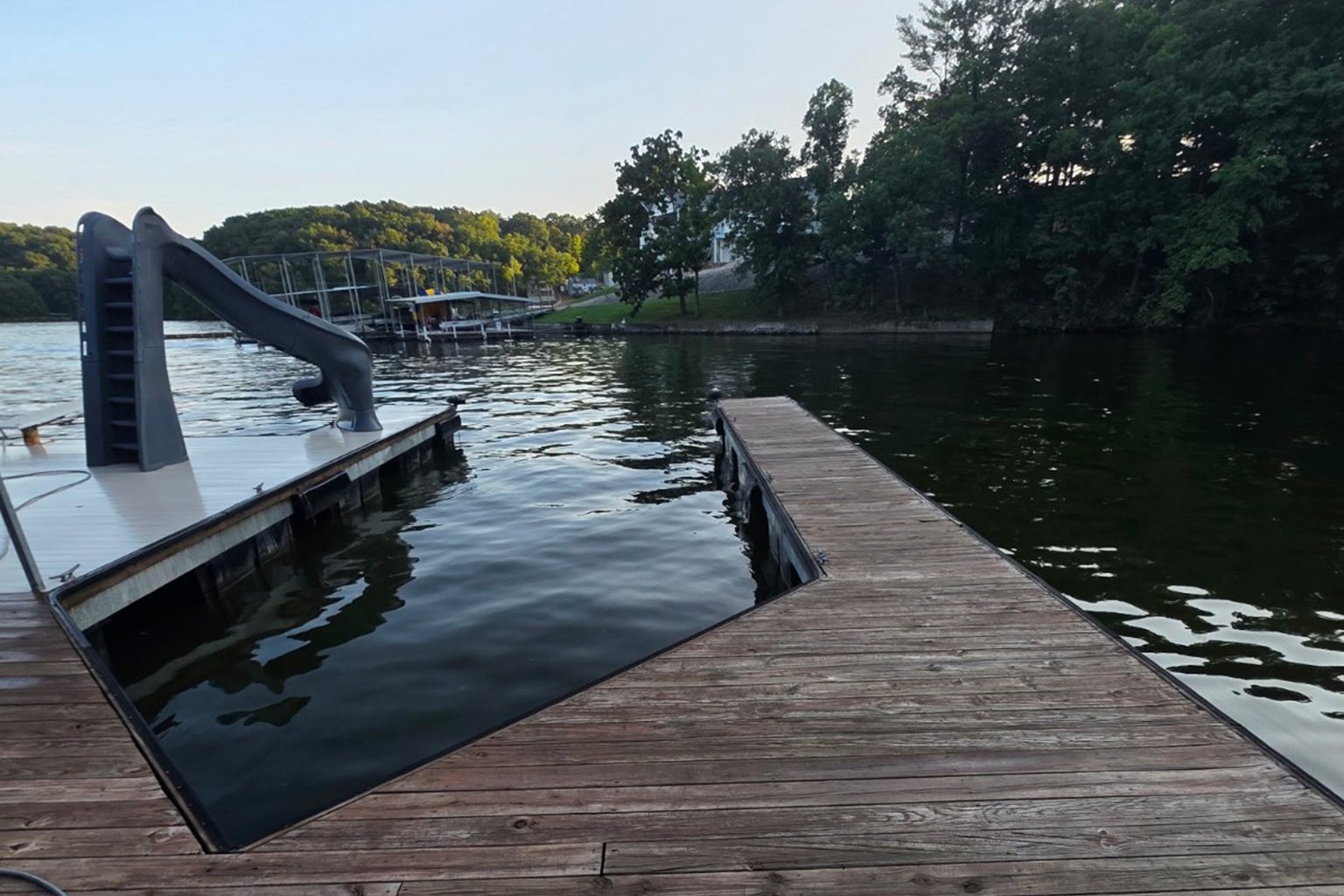
The Damage Nobody Sees Happening
Walk out onto a deck or dock that hasn’t had a protective stain applied in a few seasons and you can see the result of UV exposure without needing to know the chemistry behind it — the gray color, the rough surface texture, the slight fuzziness of raised grain, the fine cracks running along the wood fiber that weren’t there when the boards were new. The wood that looked rich and clean after its last staining has become something that looks permanently weathered, permanently aged.
Most lake homeowners notice this and think of it as cosmetic — the natural look of outdoor wood that’s been in the sun. Part of the lake aesthetic, even. Something a good cleaning and a fresh stain will fix.
What they’re actually looking at is structural degradation. The gray color isn’t just a surface phenomenon. The rough texture and raised grain aren’t just a finishing problem. The fine surface cracking is the visible edge of a process that has been working on the wood fiber below the surface — a process that UV radiation drives continuously on every unprotected deck and dock surface facing the sun.
At Lake of the Ozarks, where south and west-facing deck and dock surfaces receive intense afternoon sun that’s amplified by reflection off the water below, UV damage advances faster than on comparable surfaces in shadier inland environments. My Handyman LOZ has been maintaining, repairing, and restoring decks and docks throughout Lake Ozark, Osage Beach, Camdenton, Sunrise Beach, Laurie, Four Seasons, Porto Cima, Linn Creek, Eldon, and the surrounding communities since 1992. This article explains exactly what UV does to deck and dock wood — and what the protective approach that interrupts it looks like.
**📞 Call (573) 217-6060 | Text Photos for a Fast Estimate**
The Science of UV Wood Damage — What’s Actually Happening
Understanding what UV radiation does to wood fiber explains why the visible symptoms — graying, checking, grain raising, surface brittleness — are structural indicators rather than cosmetic ones.
Lignin Degradation — The Primary Mechanism
Wood is composed primarily of two structural components: cellulose, which provides tensile strength and forms the long fibers that give wood its grain structure, and lignin, which binds the cellulose fibers together and provides compressive strength and structural rigidity.
UV radiation attacks lignin specifically. The UV photons that penetrate wood’s surface layer break the molecular bonds in lignin’s complex polymer structure — a process called photodegradation. As lignin degrades under sustained UV exposure, several things happen simultaneously:
**The surface layer loses its binding chemistry.** Lignin is what holds cellulose fibers together at the wood surface. As it degrades, the cellulose fibers at the surface lose their cohesion — they separate from each other and rise slightly, producing the fuzzy, raised grain texture that characterizes UV-damaged wood. This raised grain is not just a texture issue; it’s the physical evidence of the surface fiber losing its structural coherence.
**The wood surface becomes darker, then lighter.** In the early stages of UV degradation, the breakdown products of lignin photodegradation produce darker coloration — the initial darkening that some homeowners notice before the gray sets in. As degradation advances and the surface fiber layer loses its coherent structure, the gray cellulose fibers become the dominant visible color — which is where the characteristic gray weathered appearance comes from. The gray isn’t a stain or a discoloration in the traditional sense; it’s the exposed cellulose fiber surface that remains after lignin has been degraded away.
**Surface micro-fractures develop.** The thermal cycling that accompanies UV exposure — deck surfaces heating significantly during afternoon sun and cooling overnight — creates dimensional stress in wood that has lost the lignin binding that gives it cohesion. Micro-fractures develop along the grain structure, initially as the fine surface checking visible to the eye, then deepening as UV degradation continues to compromise the surface fiber layer.
How UV Degradation Opens Wood to Moisture Damage
UV damage and moisture damage are not separate problems — they amplify each other in a compounding cycle that accelerates overall wood deterioration.
Intact, protected wood has a surface cell structure that limits moisture infiltration — even without applied sealant, the cellular organization of sound wood provides some natural moisture resistance. UV-degraded wood has lost the lignin binding that creates that cellular organization. The raised, separated surface fibers absorb moisture more aggressively than intact wood grain. The micro-fractures that UV creates become direct channels for moisture infiltration into the wood’s structural core.
The result is wood that, after UV degradation has compromised its surface, absorbs and retains moisture at significantly higher rates than it would have before UV exposure — which accelerates the biological growth that mold and algae need, which advances the structural deterioration that biological growth drives, which produces the soft spots and structural failure that require board replacement.
This is why UV-damaged deck and dock boards at Lake of the Ozarks don’t just look old — they develop structural problems faster than boards in better-protected condition. The UV damage that looks cosmetic is opening the door to the moisture and biological damage that produces structural failure.
Why Lake of the Ozarks Is a High-UV Environment for Outdoor Wood
Not all outdoor wood exposure is equal, and Lake of the Ozarks creates specific UV conditions that make wood degradation faster here than at inland properties or properties in shadier environments.
Direct Solar Intensity
Missouri’s latitude and the clear skies that characterize summer weather at the lake deliver significant direct UV intensity on south and west-facing deck and dock surfaces through the warm season. The afternoon sun exposure on a west-facing dock or deck at Lake Ozark or Osage Beach delivers UV loading that would stress unprotected wood in any outdoor environment.
Lake Surface Reflection
This is the factor that most distinguishes UV exposure at a lakefront property from UV exposure at an inland property with comparable sun angles. The lake surface acts as a large reflective surface that bounces UV back upward onto the underside of dock structures, onto the water-facing sides of deck railings, and onto the lower boards of deck surfaces near the water.
The practical effect is that surfaces which would receive only direct solar UV at an inland property receive both direct and reflected UV at a Lake of the Ozarks lakefront position — with the reflected component adding meaningful additional UV loading, particularly in the afternoon hours when sun angles are lower and lake surface reflection is more directly aimed at deck and dock surfaces.
Absence of Shade on Open-Water Positions
Many Lake of the Ozarks docks and decks — particularly on the main channel and on properties with open water exposure — receive direct afternoon sun without the tree canopy that might provide some shading on wooded inland lots. While shade creates its own maintenance challenges (mold and algae), it does limit UV loading on the surfaces it covers. Open-water positions at Lake Ozark, Osage Beach, and along the Linn Creek corridor receive full unshaded UV through afternoon hours.
Combined UV and Thermal Cycling
The same afternoon sun that delivers UV loading also heats deck and dock surfaces significantly — west-facing dock boards and deck surfaces can reach surface temperatures well above ambient air temperature on a sunny Missouri afternoon. The thermal cycling that this creates — significant heating during sun exposure, cooling overnight — stresses UV-degraded wood more aggressively than the same UV exposure in a milder thermal environment.
What UV-Damaged Wood Looks Like at Each Stage
Recognizing the stages of UV damage helps lake homeowners assess where their deck and dock surfaces are in the degradation progression — and whether cleaning and staining, targeted board replacement, or more comprehensive restoration is the right response.
Stage 1 — Early UV Weathering (Fully Reversible With Cleaning and Staining)
Early UV weathering produces the initial gray color change and slight surface texture change that appears on unprotected wood within one to two seasons of sun exposure. The lignin degradation is surface-level at this stage — the deeper wood fiber structure remains intact, and the surface fiber coherence, while reduced, hasn’t yet produced significant mechanical separation of the grain.
At Stage 1, professional cleaning followed by quality penetrating stain with UV inhibitors restores the surface to protected condition. The stain penetrates the slightly opened grain, bonds with the intact deeper fiber, and establishes the UV protection that prevents Stage 2 progression. This is the stage where protective staining delivers maximum value — the wood is still in good structural condition and the stain is applied to intact fiber that will hold the finish for multiple seasons.
Stage 2 — Established UV Weathering (Cleanable, Some Permanent Surface Change)
After two to four seasons of unprotected sun exposure, UV degradation has advanced to a deeper surface layer. Grain raising is pronounced and roughness is significant. Surface micro-fractures are visible. The gray coloration is deep and consistent across sun-exposed surfaces.
At Stage 2, professional cleaning improves appearance significantly but may not restore the original smooth surface texture — the grain raising that comes from lignin degradation at this depth can’t be fully reversed. Sanding after cleaning smooths the raised grain and provides a better surface for stain application. Penetrating stain applied after cleaning and sanding provides protective coverage, but the wood’s advanced UV weathering means it may absorb stain unevenly due to the varied fiber density across degraded and less-degraded areas.
Stage 2 boards are still structurally sound in most cases — the degradation is in the surface layer rather than the structural core. But they’ve lost the surface integrity that makes a stain job hold cleanly and evenly for multiple seasons.
Stage 3 — Advanced UV Weathering With Moisture Damage (Board Assessment Required)
When UV degradation has opened the wood surface enough that moisture infiltration has been occurring at elevated rates for multiple seasons, the UV damage and moisture damage have compounded to the point where structural assessment is necessary before any treatment decision is made.
The pressing test determines whether structural fiber has been compromised — soft or spongy response means the compounding UV and moisture damage has reached structural capacity and replacement is the right answer. Firm response means the structural fiber is still intact despite the significant surface degradation, and cleaning, preparation, and staining can extend the board’s service life.
At Stage 3, replacement boards installed alongside heavily UV-weathered boards that are still structurally sound will require separate treatment considerations — new lumber and heavily weathered old lumber have different surface chemistries and moisture contents that affect stain penetration and color differently.
Stage 4 — Structural Failure (Replacement Required)
When UV and moisture damage have compounded to the structural failure stage — boards that compress, crack, or break under normal foot traffic — replacement is the only correct response. The structural fiber capacity is gone, and no surface treatment addresses what the combined UV and moisture damage has done to the wood’s load-bearing capability.
The Stain That Provides Real UV Protection — What to Look For
Understanding UV damage makes it clear why the type of stain applied to deck and dock wood matters as much as the timing and preparation. Not all deck stains provide equivalent UV protection, and the difference in performance between stains with genuine UV inhibition and stains without it is measurable in seasons of additional service life.
Penetrating Stains vs. Film-Forming Stains
**Film-forming stains** and paints sit on the wood surface rather than penetrating into the fiber — they protect by creating a surface barrier rather than integrating with the wood structure. For UV protection specifically, film-forming finishes can be effective initially, but when they begin to fail — and all film-forming finishes eventually crack, peel, or chip — the failure mode creates problems. Cracked or peeling film traps moisture behind it, accelerating the moisture damage that was being prevented. Remediation requires stripping the failed film before any reapplication.
**Penetrating stains** absorb into the wood fiber rather than forming a surface film. They protect by occupying the pore structure and surface cells that would otherwise absorb moisture, and by providing UV-absorbing compounds within the wood fiber rather than on its surface. When a penetrating stain eventually wears away, it does so gradually and uniformly rather than cracking and peeling — reapplication can go directly over the surface without stripping.
For Lake of the Ozarks deck and dock wood, penetrating stain is the correct choice in most circumstances — both for UV protection and for moisture resistance in an environment where film failures create more problems than they solve.
UV Inhibitors and Stabilizers
Quality deck and dock stains formulated for exterior wood protection contain UV absorbers or UV stabilizers — compounds that absorb or scatter UV radiation before it reaches and begins photodegrading the lignin beneath the stain surface. These compounds have finite capacity — they degrade over time as they absorb UV load — which is why stain applications need periodic renewal rather than lasting indefinitely.
The presence and quality of UV inhibitor chemistry in a stain product is a significant determinant of how long the stain provides effective UV protection. Budget stain products with minimal UV inhibitor chemistry may provide some initial moisture resistance but fail to deliver the UV protection that extends wood life at an open-water Lake of the Ozarks position.
The Preparation Requirement
UV-damaged wood surfaces absorb stain differently than protected surfaces — and the cleaning and surface preparation that precedes staining determines whether the stain penetrates into the wood fiber correctly or sits on the surface inconsistently.
Professional cleaning removes the biological growth, oxidation layer, and surface contamination that prevents proper stain penetration. On Stage 2 UV-damaged surfaces, light sanding after cleaning smooths raised grain and creates a more uniform surface for stain application. Full drying after cleaning — typically 48 to 72 hours minimum — ensures the stain is penetrating into wood fiber rather than being diluted by residual moisture in the surface cells.
This preparation sequence is what determines whether a stain job delivers the UV and moisture protection that the product is capable of providing or produces an inconsistent result that fails faster than it should.
The Dock-Specific UV Challenge
Dock wood faces UV exposure conditions that deck wood doesn’t always share — and those conditions create some specific UV protection challenges worth addressing separately.
**Dock surfaces that are alternately wet and dry** experience a UV damage cycle that differs from consistently dry deck surfaces. When wet dock wood dries in direct sun, the surface drying creates additional stress on the fiber structure that compounds with the UV photodegradation. The combination of wet-dry cycling and UV exposure produces surface checking faster than UV alone would on a drier surface.
**Dock railings and vertical surfaces** on the water-facing side receive both direct UV from above and reflected UV from the lake surface below. This dual-direction UV exposure means water-facing dock railing surfaces experience higher UV loading than the same railing on a deck away from the water.
**Dock board undersides** in direct sunlight positions — docks without roofs or shade structures — absorb UV on the upper surface while absorbing moisture from the lake water below. The upper surface UV damage that opens wood grain to moisture infiltration combines directly with the moisture source immediately below, creating a more aggressive compounding cycle than the deck-above-ground position typically produces.
**Dock roof and covered dock positions** protect the dock surface from direct UV but create the shaded, damp conditions that drive the biological growth cycle instead. The maintenance challenge on covered docks shifts from UV damage to mold and algae management — which is a different problem but an equally active one in Lake of the Ozarks conditions.
How Often Does Deck and Dock Wood Need UV Protection Renewed?
The right restaining interval for Lake of the Ozarks deck and dock wood depends on several factors — but general guidance helps homeowners plan the maintenance calendar that keeps UV protection in effect:
**Sun-exposed deck and dock surfaces at main channel positions** — south and west-facing boards at full-sun Lake Ozark, Osage Beach, and similar open-water locations — typically need restaining every two to three seasons for quality penetrating stain with UV inhibitors. The UV load at these positions is high enough to exhaust UV inhibitor chemistry faster than the same stain would at a shaded inland location.
**Shaded deck and dock positions** — under tree canopy or with a dock roof — face less UV pressure but more biological growth pressure. Restaining intervals may extend to three to four seasons before UV protection needs renewal, but biological growth management between staining cycles is more important.
**After board replacement** — new pressure-treated lumber requires 30 to 90 days of drying before stain application for proper penetration. This drying window means spring board replacement leads to late-spring or early-summer staining — not immediate staining at installation.
**Signs that UV protection needs renewal** — gray color returning on sun-exposed surfaces, surface texture becoming rough again, fine checking reappearing on boards that were smooth after the last staining — all indicate that the UV inhibitor chemistry in the existing stain has been exhausted and reapplication is warranted.
Frequently Asked Questions — UV Damage to Deck and Dock Wood at Lake of the Ozarks
01. Why does deck and dock wood turn gray in the sun?
The gray color is the exposed cellulose fiber that remains after UV radiation has degraded the lignin binding those fibers together on the wood surface. Lignin is the compound that gives wood its natural color and holds the surface fibers in cohesion. As UV photodegrades lignin, the fibers separate and the gray cellulose becomes the dominant visual surface. It\u2019s not a stain or a discoloration \u2014 it\u2019s the structural evidence of lignin degradation.
02. Is gray deck wood structurally compromised or just cosmetically weathered?
Both, depending on how far the UV degradation has progressed. Early gray coloring is primarily a surface phenomenon with limited structural impact \u2014 the deeper fiber structure is still intact. As UV weathering advances over multiple unprotected seasons, the surface degradation combines with moisture infiltration to produce structural fiber compromise in the most affected boards. The pressing test \u2014 firm underfoot means structurally sound, spongy or soft means structural compromise \u2014 is the definitive assessment.
03. Does deck staining actually prevent UV damage or just slow it down?
Quality penetrating stain with UV inhibitors substantially slows UV degradation \u2014 it doesn\u2019t eliminate it entirely, but it extends the period before lignin photodegradation reaches damaging levels by providing UV-absorbing compounds within the wood fiber. The effectiveness is finite \u2014 UV inhibitor chemistry in the stain degrades as it absorbs UV load, which is why periodic restaining renews the protection rather than being a permanent solution.
04. Can UV-damaged gray deck boards be restored to their original appearance?
With professional cleaning, light sanding, and quality stain application, early-to-moderate UV weathering can be significantly improved \u2014 the boards won\u2019t typically return to the appearance of freshly installed new lumber, but they can be cleaned and protected to a condition that looks well-maintained and that extends their structural service life. Advanced UV weathering with permanent surface texture change may retain some roughness after preparation, but staining still provides the UV and moisture protection that prevents further deterioration.
05. Is UV damage worse on dock wood than on deck wood at the lake?
Often yes, for several reasons specific to dock positions. Open-water docks receive both direct UV from above and reflected UV from the lake surface, creating higher total UV loading than most deck positions. Dock boards that cycle between wet and dry conditions experience a UV-plus-wet-dry-cycling damage mechanism that compounds faster than UV alone on consistently dry deck surfaces. And dock boards without overhead shade protection are fully exposed through all daylight hours rather than benefiting from any canopy shading.
06. What\u2019s the best stain for UV protection on a Lake of the Ozarks dock or deck?
A quality penetrating stain with UV absorbers or stabilizers, applied to properly cleaned and dried wood, is the right specification. The key qualities: penetrating rather than film-forming (penetrating stains don\u2019t crack and peel as they age), UV inhibitor chemistry present in meaningful concentration (budget products often have minimal UV protection), and mildewcide additive for biological growth resistance. My Handyman LOZ assesses each property\u2019s specific UV exposure conditions and recommends appropriate products for the specific situation.
07. Protecting What You\u2019ve Built From the Sun That Comes With the View
The lake view that makes Lake of the Ozarks properties worth having comes with afternoon sun that works on unprotected deck and dock wood continuously through every warm season. UV damage is predictable, progressive, and reversible in its early stages \u2014 and preventable with the consistent protective staining that keeps the lignin in deck and dock wood from being photodegraded into the gray, rough, moisture-absorbing surface that deferred maintenance produces.
My Handyman LOZ has been cleaning, preparing, and staining deck and dock wood on Lake of the Ozarks properties since 1992. We know the UV exposure conditions at different lake positions, we prepare surfaces correctly for maximum stain penetration and UV protection, and we deliver stain results that hold through multiple seasons rather than failing in the first.
📞 Call (573) 217-6060
📱 Text Photos for a Fast Estimate
🌐 Schedule Your Annual Exterior Washing — Contact My Handyman LOZ
*Serving Lake Ozark, Osage Beach, Camdenton, Sunrise Beach, Laurie, Four Seasons, Porto Cima, Linn Creek, Eldon, and the surrounding Lake of the Ozarks communities since 1992.*